Comparing your options
How to Choose an Implant Dentist: What to Look For in the UK
For patients comparing implant dentists before committing to treatment: this page sets out the credentials, training, technology, and consent standards that separate a well-prepared implant clinician from a general dentist offering implants. Core takeaway: GDC registration is the legal floor, not the ceiling — look for implant-specific postgraduate training, in-house CBCT, and written planning.
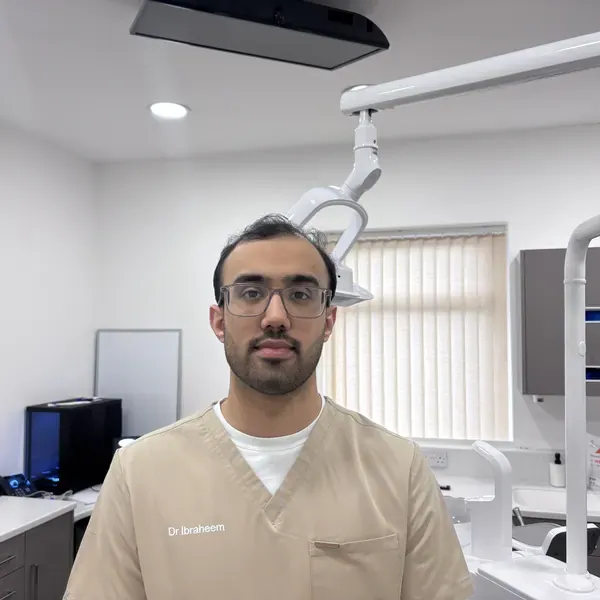 Clinically reviewed by Dr Ibraheem Ijaz, Principal Dentist · GDC 301711 · 500+ implants placed · Last reviewed August 2026
Medical disclaimer: This page is for general information only. It does not replace an examination or treatment by a dentist.
How do you choose a good implant dentist in the UK?
Choose an implant dentist by verifying GDC registration, confirming implant-specific postgraduate training, checking in-house CBCT imaging, and reviewing their written treatment plan.
These four checks matter because implant dentistry in the UK is not a General Dental Council (GDC) recognised specialty — any registered dentist is legally allowed to place implants. The responsibility for verifying real competence sits with the patient. The Faculty of General Dental Practice (FGDP(UK)) Training Standards in Implant Dentistry, now held by the College of General Dentistry, is the benchmark the GDC itself refers to when investigating complaints. Patients who use it as a checklist are effectively applying the same framework the regulator uses. Many patients who start comparing implant dentists are not just asking who is good — they are trying to work out what “good” even means in a field that lacks a protected title. That uncertainty is reasonable, and it is the reason this page exists. Alongside credentials, you are looking for continuity, meaning the same clinician both places and restores the implant, and for evidence, meaning recognised implant systems with long-term clinical data. Transparency is the third pillar: the treatment plan should be written, priced, and explained before you commit. A clinic hesitant on any of these points is worth questioning further before committing.
Is there such a thing as a “specialist” implant dentist in the UK?
No — implant dentistry is not on the GDC Specialist List, so no UK dentist can legally hold the title “Specialist Implant Dentist”.
The General Dental Council recognises thirteen dental specialties, including Oral Surgery, Prosthodontics, and Periodontics. Implant dentistry is not one of them. This is one of the most misunderstood points in the entire field. Any UK dentist with full GDC registration is legally permitted to place implants, provided they work within the limits of their competence as required by the GDC Standards for the Dental Team. What distinguishes a serious implant dentist from a generalist who occasionally places them is not a protected title but postgraduate qualification, case volume, mentorship history, and regulatory literacy. When a website advertises a “specialist implant dentist”, that wording is non-compliant unless the clinician is on the GDC Specialist List for a related specialty such as Oral Surgery. Honesty about this is itself a green flag — clinicians who explain it to you are demonstrating the kind of regulatory awareness you want in the person performing a surgical procedure in your mouth.
What qualifications should an implant dentist have?
A well-trained implant dentist should hold full GDC registration plus a recognised postgraduate qualification in implant dentistry, typically a PG Diploma or MSc.
The UK benchmark is Training Standards in Implant Dentistry (TSID), first published by the FGDP(UK) in 2005 and revised in 2016. It sets out the theoretical knowledge, clinical competencies, and mentored practice expected before a dentist independently delivers implant treatment. A 2018 review in the International Journal of Implant Dentistry noted that TSID has driven meaningful improvement in UK implant training quality. You can verify any dentist’s GDC registration in under a minute on the GDC online register — this is free, public, and the single most important first step. Look for a registered PG Diploma or Master’s degree in Implant Dentistry from a recognised UK or international institution. Short CPD courses alone are not equivalent to structured postgraduate training. Membership of international bodies such as the International Team for Implantology (ITI) can be a reasonable additional signal of evidence-based education, though it is voluntary and not a UK regulatory requirement. You can explore Dr Ibraheem Ijaz’s clinical background and technology on the practice’s clinician profile page.
Still weighing it up? Talk it through with Dr Ijaz.
What technology and planning should the practice have?
The practice should have in-house Cone-Beam CT (a 3D dental scanner known as CBCT) and a documented justification process for every scan.
CBCT provides the three-dimensional assessment of bone volume, nerve position, and sinus anatomy that two-dimensional X-rays cannot. TSID 2016 explicitly requires adequate CBCT knowledge and full compliance with the Ionising Radiation (Medical Exposure) Regulations 2017 — IR(ME)R, the UK law governing justification of any medical radiation exposure. In clinical practice, the most avoidable implant complications are rarely caused by the implant itself; they are traced back to planning gaps that a proper 3D assessment would have caught. Most are manageable when identified early. A practice that outsources every scan, or cannot explain when and why a CBCT is justified, may be operating below the standard patients should expect. In-house imaging also matters for continuity — the clinician placing the implant should be the person interpreting the scan. Surgical guides produced from CBCT data allow the planned implant position to be transferred precisely to the surgery, which reduces the margin for error, particularly in the aesthetic zone. For a fuller breakdown of how 3D planning works in practice, see the page on CBCT-guided implant planning.
How much experience should an implant dentist have?
There is no UK-mandated minimum case number, but patients can ask how many implants a dentist has placed and whether they also restore them.
Experience is a spectrum, and honesty about it matters more than a specific figure. A dentist who has placed 200 implants with structured mentorship is not directly comparable to one who has placed 500 without. The CGDent Mentoring in Implant Dentistry: Good Practice Guidelines (2022) reinforces that mentorship — not raw volume — is the accepted development pathway. Ask three things: how many years they have been placing implants, whether they received formal mentorship during their early cases, and whether they handle complex cases in-house or refer out. Continuity matters: a dentist who both places and restores the implant takes responsibility for the whole outcome. At Deepcar Dental Care, Dr Ibraheem Ijaz has placed and restored 500+ implants since 2022, trained under experienced implant mentors, and works as a duo with an experienced implant colleague, Mohammed Anabtawi, on complex cases — a realistic description of a clinician operating within clearly-defined competence limits. At consultation, patients are given a clear written treatment plan before any commitment, so decisions can be made calmly and with full information.
What implant brands and systems should they use?
A serious implant practice uses established systems with long-term clinical research and guaranteed component availability — not unsupported or discontinued alternatives.
Brand alone does not guarantee outcome, but the underlying principle matters: implants are restorations you live with for decades, and the screws, abutments, and components must remain available for future maintenance, repair, or replacement. Established systems such as Straumann, Nobel Biocare, Neodent, Dentium, and Sweden & Martina each have documented long-term clinical literature and robust component supply chains. A practice using only unbranded or discontinued systems creates a risk the patient inherits later. Ask what system will be used, why, and whether components will still be supported in ten or twenty years. Deepcar Dental Care uses multiple recognised systems so the clinical decision can be driven by the case — bone volume, aesthetic zone, load — rather than by what happens to be in stock. For patients specifically searching for dental implants in Sheffield, implant system flexibility is one concrete factor patients can compare directly.
Still weighing it up? Talk it through with Dr Ijaz.
Red flags and green flags when comparing implant clinics
Green flags are written treatment plans, named clinicians with displayed GDC numbers, and in-house CBCT; red flags are pressure selling, verbal-only quotes, and “specialist” claims.
Green flags: clinician named on the website with GDC number displayed; PG Diploma or MSc in Implant Dentistry stated explicitly; in-house CBCT; transparent written pricing with itemised costs and clearly-explained finance options before any deposit; a clear written consent process; a named aftercare and complications policy; the same clinician handles placement and restoration; honest acknowledgement that implant dentistry is not a protected specialty; proposed implant system named openly.
Red flags: “specialist implant dentist” claims without a GDC Specialist List entry; no CBCT or outsourced imaging with no clinical justification; verbal-only treatment plans; pressure to pay a deposit at the first visit; unclear what happens if an implant fails; unbranded or undisclosed implant system; no visible clinician biography; prices significantly below UK market norms, which can signal a cost saving somewhere the patient cannot see.
What questions should I ask at an implant consultation?
Ask for the clinician’s GDC number, their postgraduate qualification, the proposed implant system, and a written treatment plan before committing.
Bring these questions with you: What is your GDC registration number? What postgraduate implant qualification do you hold? How many implants have you placed and restored personally? Will you place and restore my implant, or does someone else do the restoration? Which implant system are you recommending and why? Will a CBCT be taken before surgery? Can I see the written treatment plan and full cost breakdown before I decide? What happens, practically, if the implant fails or needs replacing in five or ten years? A clinician’s willingness to answer openly is itself informative.
Questions, answered
Frequently asked questions
Is any UK dentist allowed to place dental implants?
Yes — any dentist with full GDC registration may legally place implants, provided they work within the limits of their own competence as required by the GDC Standards for the Dental Team. The legal floor is low; the clinical floor set by the FGDP/CGDent Training Standards in Implant Dentistry is considerably higher.
How do I verify a dentist’s GDC registration?
Patients often ask this after reading conflicting advice online, because the process sounds more complicated than it is. Visit the GDC online register at olr.gdc-uk.org and search by name, town, or GDC number. The search is free, public, and takes under a minute. A valid entry confirms lawful practice but not implant-specific training.
Does ITI membership mean an implant dentist is better?
ITI (International Team for Implantology) membership is voluntary and not a UK regulatory requirement, so it does not guarantee competence. It can indicate engagement with evidence-based implant education and international CPD, which is a reasonable positive signal — but weigh it alongside formal postgraduate qualifications and mentored experience.
Should the same dentist place and restore my implant?
Continuity of care is generally preferable. A clinician who handles both surgical placement and the final restoration takes full responsibility for the outcome and can adjust the plan between stages. Split-team arrangements are not unsafe, but they place more weight on clear communication between clinicians and patient handover.
Why does it matter which implant brand is used?
Implant components — screws, abutments, crowns — need to remain available for maintenance and repair across decades. Established systems with documented long-term clinical research and reliable component supply protect you from inherited problems ten or twenty years later. Ask which system is proposed and whether components will still be supported.
How much does a dental implant consultation cost at Deepcar?
Consultation and CBCT imaging at Deepcar Dental Care are charged at set, transparent fees, with the consultation fee typically redeemable against the cost of treatment if you proceed. For current figures across consultation, CBCT, implants, bone grafting, and full-arch treatment, see the up-to-date practice fees page. Finance options are available through Tabeo for eligible patients.
Ready when you are
The next step
If you have worked through the criteria on this page, you likely have a clearer picture of what separates a well-prepared implant dentist from one who simply offers implants. The next step is a conversation with a clinician who can assess your specific situation.