The complete guide
The Complete Guide to Dental Implants — Procedures, Eligibility, Costs, Healing & Long-Term Ownership
This page is for adults considering dental implants who want a single, complete reference covering how implants work, who they suit, what the procedure involves, healing, long-term care and cost. Core takeaway: a dental implant is a long-term, evidence-backed way to replace a missing tooth or teeth, but it is a clinical decision that depends on your bone, gums, general health and goals — not a one-size product.
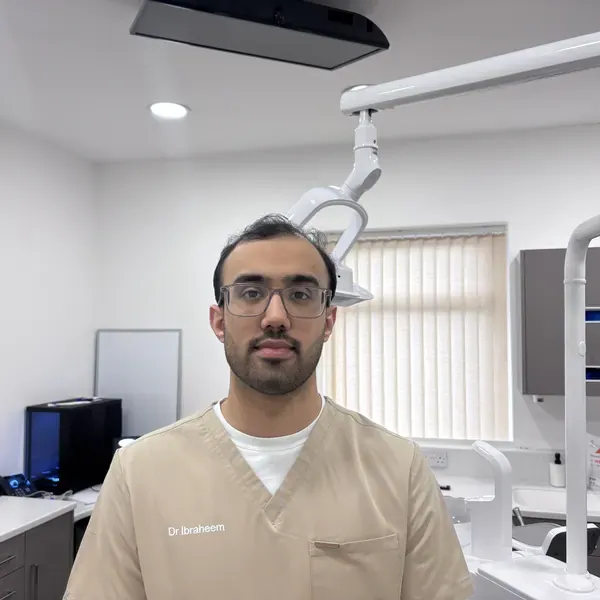 Clinically reviewed by Dr Ibraheem Ijaz, Principal Dentist · GDC 301711 · 500+ implants placed · Last reviewed August 2026
Medical disclaimer: This page is for general information only. It does not replace an examination or treatment by a dentist.
What is a dental implant?
A dental implant is a titanium fixture placed in the jawbone that acts as an artificial tooth root supporting a crown, bridge or denture.
In practice, “a dental implant” usually refers to three components working together: the implant itself (the screw-shaped titanium fixture in the bone), an abutment (the connector that sits at gum level), and the restoration on top — typically a crown for a single missing tooth, a bridge for several teeth, or a fixed or removable denture for a full arch. The implant integrates with the bone over a healing period and then carries chewing forces.
The reason implants have become a mainstream tooth-replacement option is biological. Titanium has an unusual property: living bone will bond directly to its surface under the right conditions, a phenomenon called osseointegration. That bond is what allows an implant to feel and function like a fixed part of the mouth rather than something resting on the gums.
Many patients who enquire about dental implants are not just asking what one is — they want to know whether implants are right for their specific situation. The honest answer almost always depends on the individual clinical picture: the bone, the gums, the general health and the goals of the person sitting in the chair. That is why the rest of this guide is structured as a journey rather than a sales pitch.
Implants are not the only way to replace missing teeth — bridges and dentures remain valid options, and the right choice depends on the clinical picture. What sets implants apart is that they replace the root as well as the visible tooth, which helps preserve bone in the area and avoids putting load on neighbouring teeth. For a fuller overview of the implant services on offer here, explore whether dental implants could work for you.
How dental implants work — the science of osseointegration
Dental implants work because titanium forms a direct structural bond with living bone — a process called osseointegration that takes weeks to months.
The term osseointegration was defined by the Swedish researcher Per-Ingvar Brånemark in 1983 as “a direct structural and functional connection between ordered, living bone, and the surface of a load-carrying implant.” Brånemark’s research in Sweden established the modern technique, and the first titanium dental implant was placed in a human patient in 1965.
Biologically, what happens after an implant is placed follows the pattern of bone healing. New bone begins to form on the implant surface within the first weeks, and bone remodelling — the ongoing process by which bone reshapes itself in response to load — starts between roughly six and twelve weeks and continues for the life of the implant (Smeets et al., Periodontology 2000, 2016). The exact timeline depends on the site (lower jaw bone tends to integrate faster than upper jaw bone), the density of the bone, the implant system used and the patient’s general health.
Modern implants are designed to make this process as predictable as possible. Most contemporary systems use a roughened, sandblasted and acid-etched surface — the current gold standard for accelerating bone bonding (Smeets et al., 2016) — and some use additional hydrophilic chemical modifications (such as the SLActive surface developed by Straumann), which evidence suggests can accelerate early healing. For patients who prefer a metal-free option, ceramic implants made from yttria-stabilised zirconia (Y-TZP) are also available, though the long-term clinical evidence base for titanium is substantially larger than for zirconia.
For a deeper explanation of the science behind implant placement and how clinicians monitor early stability — including measurements such as the Implant Stability Quotient (ISQ) — see our dental implant science section.
The full patient journey — from first question to fitted teeth
The dental implant journey runs in clear stages: consultation and assessment, treatment planning, implant placement, healing, restoration, and long-term aftercare.
Most people start the journey with a question rather than a decision. They have a tooth that has failed, a denture that no longer fits, or a long-standing gap they have lived with — and they want to know whether implants are realistic for them. The first stage is a consultation in which the clinician listens to what is bothering you, examines the area, takes a CBCT (cone beam computed tomography) 3D scan if needed, and explains the options honestly, including non-implant alternatives.
Dr Ibraheem Ijaz, our principal implant dentist at Deepcar Dental Care, treats every case as if it were his own mouth — explaining all the options, including non-implant alternatives, before recommending one.
If implants look like a sensible direction, the next stage is treatment planning. This is where bone volume, gum health, the position of nerves and sinuses, your medical history and your goals are all brought together into a written plan. Some patients need preparatory work first — for example, treating gum disease, extracting a tooth, or building bone with a graft. This is also the stage at which cost, finance options and timescales become concrete rather than hypothetical.
Implant placement itself is a minor surgical procedure carried out under local anaesthetic, often more comfortable than patients expect. After placement, there is a healing period during which the bone bonds to the implant. The length of this phase varies — sometimes a temporary tooth is fitted in the meantime so you are never without a visible tooth.
Once healing is complete, the final restoration — crown, bridge or denture — is fitted onto the implant. From that point on, the focus shifts to long-term ownership: regular check-ups, hygienist visits and good day-to-day cleaning, all of which are essential for keeping the tissues around the implant healthy.
Who is suitable for dental implants?
Most adults with stable general health, healthy gums and adequate jawbone are suitable for dental implants — confirmed by clinical assessment.
The questions a clinician will work through during your consultation are practical rather than mysterious. Is there enough bone in the right place to hold an implant — something a CBCT scan can answer with precision? If not, can it be built up safely with grafting? Are the gums healthy, or is there active gum disease that needs to be brought under control first? Is your general health stable, and are any medications you take going to affect healing? How heavy a smoker are you, if at all? And how realistic are your expectations about how long the whole process will take?
Some factors are well-established as making implants more challenging or, in some cases, inadvisable. Untreated gum disease and untreated decay are typically resolved before implant treatment starts. Poorly controlled diabetes increases the risk of complications and is usually managed first. A history of treated gum disease is not a barrier, but it does mean closer long-term monitoring, because the same factors that affect gums also affect the tissues around implants. Smoking is consistently linked with higher rates of implant complications and failure, and most clinicians will discuss cutting down or stopping as part of planning.
Age in itself is rarely the deciding factor. Older patients with stable health are routinely treated successfully, and the relevant question is bone and tissue health rather than date of birth. What matters most is that the assessment is honest, the limitations are explained, and you leave the consultation knowing whether implants are a good fit for you — not for an average patient. For a more detailed walk-through of the eligibility factors and what each one means in practice, see our dental implant eligibility page.
Prefer to ask in person? Book a consultation with Dr Ijaz.
Types of dental implant treatment
Dental implants can replace a single missing tooth, several teeth or a full arch — the right approach depends on the clinical picture.
Single-tooth implants are the most familiar use case: one implant supports one crown to replace one missing tooth. They are commonly chosen because they avoid grinding down the healthy teeth either side of the gap (which is what a traditional bridge requires) and because they help preserve bone in the area. You can read more on our single tooth dental implant page.
Multiple implants and implant bridges are used when several adjacent teeth are missing. Rather than placing one implant per missing tooth, two or more implants can support a small bridge, which is often a more cost-effective and less invasive approach.
Full-arch implant treatment replaces an entire upper or lower set of teeth using a fixed bridge supported by several strategically placed implants. The most well-known of these techniques is the All-on-4 dental implants approach, which uses four implants per arch — including angled implants at the back — to support a fixed full-arch bridge, often without the need for extensive bone grafting.
Implant-retained dentures sit somewhere between conventional dentures and a fully fixed bridge. A small number of implants — often two in the lower jaw — are used to clip a denture firmly in place, dramatically improving stability and chewing function compared to a denture resting on the gums alone, while remaining removable for cleaning.
The choice between these options is not purely about cost. It depends on how much bone is present, where the missing teeth are, what the opposing teeth look like, and what matters most to you in daily life — whether that is the security of a fixed bridge, the simplicity of a removable option, or the most conservative use of the bone you still have. For a fuller breakdown across all options, see our dental implant treatment options section.
The dental implant procedure explained
The dental implant procedure is a minor surgical placement carried out under local anaesthetic, usually completed in a single appointment for each implant.
Before the day of placement, the planning is already done. The clinician knows from the CBCT scan exactly where the implant will go, at what angle, and how deep, so the appointment itself is methodical rather than exploratory. The area is numbed with local anaesthetic; for anxious patients, oral or intravenous sedation can be discussed in advance. A small opening is made in the gum over the implant site, the bone is prepared with a series of precision drills under irrigation, and the implant is placed into the prepared site.
In some cases the implant can be placed at the same time as a tooth is removed (immediate placement), and in some cases a temporary tooth can be fitted on the same day so that you are never seen with a visible gap. In other cases the more traditional approach is used: the implant is allowed to heal under the gum first, and the visible tooth is added later. Which route is best depends on the bone, the position of the tooth and the aesthetics involved — there is no single “correct” answer.
The local anaesthetic means the placement itself is not painful, and many people describe the experience afterwards as more comfortable than the extraction of a tooth. Mild swelling and tenderness for a few days are normal and usually managed with simple over-the-counter painkillers and the aftercare instructions you will be sent home with.
Healing, recovery and what to expect
Healing after an implant takes weeks to months — soft tissue settles within days, while bone bonding continues for several months.
In the first few days after placement, the focus is on letting the gum settle. Most people return to normal activities the next day. Mild swelling, bruising and tenderness are common in the first 48–72 hours and respond well to simple painkillers, soft foods, and gentle cleaning around the area. You will be given specific aftercare instructions and a follow-up appointment to check the area is healing as expected.
The biological process that matters most — osseointegration — is invisible. New bone begins forming on the implant surface within the first weeks, and the bond strengthens steadily over the following months. Bone remodelling around an implant typically begins between six and twelve weeks after placement (Smeets et al., 2016), which is why most clinicians wait several months before loading a routine single-tooth implant in good bone. The exact timeline depends on where the implant is, the quality of the bone, the implant system, and whether any grafting was done. For grafted sites or full-arch cases the healing window is longer. Your clinician will give you a realistic schedule at the planning stage, not on the day of surgery.
Day-to-day life during healing is rarely disruptive. People work, exercise, travel, and eat normally — they just avoid biting hard directly on the healing site for a defined period and take cleaning a little more carefully around the area. Many patients at Deepcar Dental Care tell us afterwards that the recovery was less disruptive than they had been expecting.
For a more detailed timeline of what each stage of recovery looks like, see our healing and aftercare guide.
Long-term ownership — looking after your implants
Looking after a dental implant is similar to caring for natural teeth: daily cleaning, regular check-ups and hygienist visits.
Implants need the same daily attention as natural teeth — and arguably more, because the gum and bone around them respond to plaque in the same way as natural tissues. Plaque left around an implant can cause inflammation in the gum (called peri-implant mucositis), and if that inflammation is not addressed it can progress to a more serious condition affecting the bone (peri-implantitis). Both are preventable in most cases with good cleaning and regular professional care.
Daily care is straightforward: brushing twice a day, cleaning between teeth and around the implant with the tools your hygienist recommends (interdental brushes or floss designed for implants), and avoiding habits that put unnecessary stress on the restoration, such as chewing pen lids or grinding teeth without protection. If you grind your teeth at night, a nightguard is a small investment that protects both natural teeth and implant restorations.
Professional care is the other half of the equation. Regular check-ups with your dentist allow problems to be picked up early — when they are easy to manage — and hygienist visits are tailored to keep the tissues around the implant healthy. Over the long term, the patients who do best are not the patients with perfect bone or perfect health histories; they are the patients who are consistent with their maintenance.
Long-term studies of implants placed using contemporary systems consistently show high survival rates. A 2019 systematic review by Howe, Keys and Richards in the Journal of Dentistry (Volume 84) reported pooled 10-year implant survival of approximately 93–96% across contemporary implant systems, with the lower end of that range applying when more conservative statistical assumptions are used and to older patients. These figures are encouraging, but they are population averages and they assume regular maintenance — which is exactly why long-term ownership matters.
For more on protecting your implant for the long term, see our dental implant care guide.
Prefer to ask in person? Book a consultation with Dr Ijaz.
Risks, complications and peri-implant disease
The main long-term risks of dental implants are biological — peri-implant disease — and mechanical, such as loosening of the restoration.
The most clinically significant long-term risk is peri-implant disease, defined by the international 2017 World Workshop consensus (Berglundh et al., Journal of Clinical Periodontology, 2018) as a plaque-associated condition characterised by inflammation in the tissues around an implant. The earlier, reversible form is peri-implant mucositis (bleeding gum without bone loss). The more advanced form is peri-implantitis, which involves progressive loss of supporting bone.
Estimates of how common peri-implantitis is vary widely depending on the case definition used, but recent systematic review evidence (Diaz et al., BMC Oral Health, 2022) puts patient-level prevalence at approximately 19.5% and implant-level prevalence at approximately 12.5%. These numbers are not meant to alarm — they are meant to be honest. They reflect the importance of selecting patients carefully, controlling modifiable risk factors, and committing to long-term maintenance. Recognised modifying factors include smoking, poorly controlled diabetes, a history of gum disease, and lack of regular professional maintenance.
In clinical practice, the majority of peri-implant complications develop gradually rather than suddenly, and they are most commonly related to plaque accumulation and missed maintenance visits rather than to anything inherent in the implant itself. Most are manageable when identified early, which is why regular check-ups are not optional extras — they are the mechanism by which problems are caught while they are still easy to treat.
Other risks are uncommon but should be discussed openly at the planning stage. They include infection at the surgical site, temporary altered sensation if an implant is placed close to a nerve (the risk of which is reduced when treatment is planned with 3D imaging that maps the position of the inferior alveolar nerve), sinus complications when implants are placed in the upper back jaw, and mechanical issues with the restoration over time, such as a screw loosening or a crown chipping. Most mechanical complications are manageable when caught early at routine check-ups.
A small number of implants do not integrate successfully and need to be removed and, in many cases, replaced after healing. Early failures of this kind are unusual and usually identified within the first months. Dental implants are one of the most predictable treatments in dentistry, but they are not risk-free, and any clinician who tells you otherwise is not giving you the full picture.
For a more detailed look at dental implant complications, how they are managed, and what good long-term monitoring looks like, see our complications cluster.
How much do dental implants cost?
Dental implant costs typically start in the low thousands per implant and rise depending on case complexity and the restoration involved.
Cost is one of the most common reasons people delay enquiring about implants, and it should be addressed openly. The honest answer is that the cost of implant treatment is driven by the clinical picture: how many implants you need, what the final restoration is (a single crown, a bridge, a full-arch reconstruction), whether bone grafting or a sinus lift is required, the implant system used, and whether sedation is part of the plan. Two patients with what looks like the same problem can end up with different treatment plans and different costs because their bone, gums and goals are not the same.
What we can be transparent about is the structure. At Deepcar Dental Care, fees are published openly, treatment is quoted in writing after assessment so you know exactly what is included, and finance options through Tabeo are available to spread the cost — including interest-free options over shorter terms and longer terms with a representative APR. Cost should never be the only reason to choose or avoid a treatment, but it should also never be a surprise.
For the full breakdown of how much does a dental implant cost at Deepcar Dental Care, and to see pay monthly dental implants finance options, visit our cost and finance pages.
Are dental implants available on the NHS?
Dental implants are not routinely available on the NHS — they are usually funded only for specific clinical needs such as cancer or trauma.
The NHS itself is clear on this. The NHS Live Well guidance on dental treatments explains that implants are usually only available privately, and that they are sometimes available on the NHS for patients who cannot wear dentures or whose face and teeth have been damaged — for example, people who have had mouth cancer or an accident that knocked a tooth out. Where NHS funding is granted, treatment is typically delivered in a hospital setting under a consultant in restorative dentistry or oral and maxillofacial surgery, and is subject to strict acceptance criteria.
The Royal College of Surgeons of England’s national selection criteria — which NHS hospital trusts apply when considering exceptional funding applications — group eligible patients into three broad clinical priority categories: edentulous patients with severe denture intolerance or significant alveolar bone loss; partially dentate patients with developmental conditions such as hypodontia, cleft palate or trauma; and patients with extensive ridge deformities or major jaw resections.
For most adults in Sheffield seeking implants — including those who have lost teeth through decay, gum disease or general wear — the realistic path is private dental implant treatment, because the NHS criteria for funding are deliberately narrow. This is not a marketing claim; it is the position set out by the NHS itself. If you think your situation may meet the clinical criteria for NHS-funded treatment, your general dentist can advise on whether a referral is appropriate.
Questions, answered
Frequently asked questions
Are dental implants painful?
Implant placement is carried out under local anaesthetic, so the procedure itself is not painful. Most patients describe the discomfort afterwards as mild and similar to, or less than, a tooth extraction. Simple over-the-counter painkillers and a few days of soft food are usually enough to manage it, and most people return to work the next day.
How long do dental implants last?
Long-term studies of contemporary implant systems consistently report 10-year survival rates of approximately 93–96%, depending on the patient group and how survival is defined (Howe et al., 2019). With good daily cleaning, regular hygienist visits and stable general health, an implant can be expected to function for many years — though the restoration on top may need maintenance over time.
How long does the whole treatment take?
A straightforward single-tooth implant case typically takes several months from placement to fitting the final crown, depending on healing. Cases involving bone grafting, immediate placement protocols or full-arch treatment can take longer. Your clinician will give you a realistic timeline at the planning stage rather than a generic estimate.
Can I have dental implants if I smoke?
Smoking is consistently linked with a higher risk of implant complications and failure, but it is not always an absolute barrier. Many clinicians will discuss reducing or stopping smoking as part of the planning conversation, because doing so meaningfully improves the chances of long-term success. Your individual situation will be assessed honestly during your consultation.
What happens if a dental implant fails?
A small number of implants do not integrate successfully or develop problems later. When this happens, the implant is removed, the area is allowed to heal, and in many cases a replacement implant can be placed afterwards. Early identification at routine check-ups is the most important factor in keeping any complication manageable.
Do dental implants look natural?
A well-planned implant restoration is designed to match the shape, shade and contour of the surrounding teeth. In the front of the mouth this requires careful attention to gum aesthetics as well as the crown itself. The clinical aim is straightforward: an outcome that does not look like dentistry has been done.
Are there any alternatives to dental implants?
Yes. Dental bridges and dentures remain valid options for many patients and may be the right choice depending on bone, budget and goals. The right way to decide between them is a balanced consultation that compares the options against your specific clinical picture, rather than starting from a single recommended answer.
If you have worked through the questions on this page, you likely have a clearer picture of whether dental implants are the right direction for you. The next step is a conversation with a clinician who can assess your specific situation, look at your bone and gums in detail, and give you a written plan you can take away and think about — without pressure to decide on the day.
Find out whether dental implants are right for you. Every implant journey at Deepcar Dental Care starts with a consultation with Dr Ibraheem Ijaz, our principal implant dentist, who will assess your situation honestly and explain all of your options — including non-implant alternatives — without pressure. Many of our patient reviews describe what to expect from that first visit. To book, call 0114 288 2121 or book a consultation online.
Keep reading
Related reading
Ready when you are
Book your implant assessment.
Online in under a minute, or call and speak to a real person.