Treatment
Sinus Lift — Bone Building for Upper Jaw Implants
This page is for adults considering a dental implant in the upper back jaw who have been told there is not enough bone to place one. It explains how a sinus lift, also called sinus augmentation, creates the bone needed for posterior upper implants, what the two main approaches involve, and what to expect through healing. Core takeaway: a sinus lift is a predictable, evidence-supported step that makes upper-jaw implants possible when bone height is too low.
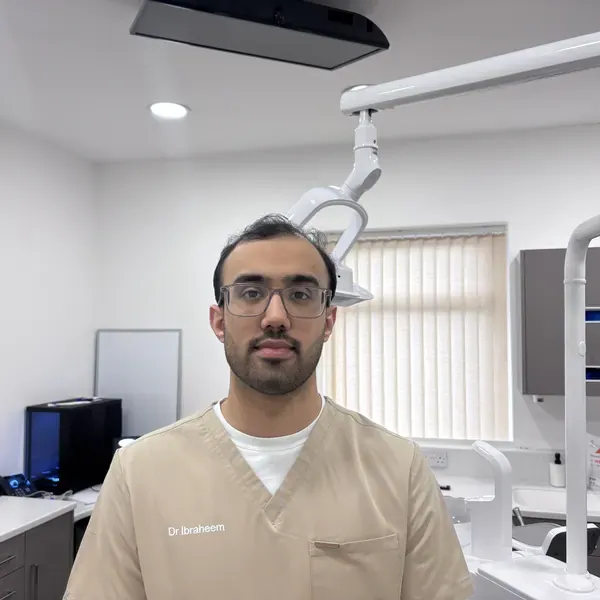 Clinically reviewed by Dr Ibraheem Ijaz, Principal Dentist · GDC 301711 · 500+ implants placed · Last reviewed August 2026
Medical disclaimer: This page is for general information only. It does not replace an examination or treatment by a dentist.
What is a sinus lift, and why is it needed for upper-jaw implants?
A sinus lift is a procedure that places bone graft material beneath the maxillary sinus to create the height needed for an upper-jaw dental implant.
The maxillary sinuses are two air-filled cavities sitting directly above the back teeth of the upper jaw. When a posterior upper tooth is lost, particularly a molar, two things happen over the months and years that follow. The alveolar bone (the part of the jaw that holds the tooth roots) that once supported the tooth resorbs downward, and the sinus cavity slowly expands into the space that bone used to occupy. Clinicians describe this as a pneumatised sinus, and it can leave too little bone height between the gum and the sinus floor to anchor a standard implant safely.
A sinus lift, properly called sinus augmentation or sinus floor elevation, addresses this by gently raising the Schneiderian membrane (the thin mucosal lining of the sinus) and placing graft material, effectively an upper-jaw bone graft, into the space beneath the sinus floor. Over a healing period, the graft consolidates into bone that can support an implant fixture. Major systematic reviews, including the 2010 Cochrane review by Esposito and colleagues and the 2008 Pjetursson and colleagues meta-analysis, conclude that sinus floor elevation is a reliable approach to enabling upper posterior implants in jaws that would otherwise lack the bone for them. Sinus augmentation is a sinus-specific procedure; for general jawbone grafting outside the sinus, see our page on bone graft for dental implants.
Many patients who enquire about a sinus lift are not really asking what it is. They want to know whether it is appropriate for their specific anatomy, and how it changes the journey to a finished upper-jaw implant. The technical detail matters, but the question underneath is usually personal: what does this mean for me, and how long will it take?
Lateral window vs crestal sinus lift, how the two approaches differ
Two main sinus-lift approaches are used: a lateral window through the side of the upper jaw, or a crestal route through the implant site itself.
In a lateral window sinus lift, a small opening is made in the bone on the cheek side of the upper jaw to access the sinus. The Schneiderian membrane is lifted carefully away from the bone, and graft material is placed into the new space. This is the more invasive of the two approaches and is generally chosen when residual bone height beneath the sinus is around 4 mm or less. The Cambridge University Hospitals NHS Foundation Trust patient information describes the lateral approach as a staged surgery in many cases, with the implant placed once the graft has matured.
In a crestal (or transcrestal) sinus lift, the dentist works through the same socket prepared for the implant. Specialised instruments called osteotomes (tapered hand instruments designed to compress and lift bone) are used to gently fracture and lift the sinus floor upward, and graft material is introduced through the implant osteotomy itself, where it consolidates into bone over a healing period. Tatum first described a transcrestal sinus elevation in 1986; Summers refined the technique in 1994 with the bone-added osteotome sinus floor elevation (BAOSFE) protocol that is still widely used today. The crestal route is less invasive, generally used when at least 5 mm of residual bone height is present, and frequently allows the implant to be placed at the same appointment.
The 1996 Consensus Conference on Maxillary Sinus Elevation framed sinus floor elevation as a function of residual bone height. Standard implant placement is appropriate when 10 mm or more is available; a crestal approach with simultaneous implant when 7 to 9 mm is available; and a lateral window approach when bone height falls below that, with the implant placed at the same time when residual height supports it, or staged separately when bone height is at its lowest. Modern practice still follows the spirit of these categories, refined by how CBCT scanning creates a 3D map of your jaw before surgery so the surgeon can see the exact sinus shape, membrane condition, and bone available before treatment begins.
A separate, older operation called the Caldwell-Luc procedure is sometimes confused with a sinus lift because it shares the same anatomical access route. It is, however, a separate operation. Caldwell-Luc is a historical antrostomy used to manage chronic maxillary sinus disease or to retrieve foreign bodies (including, occasionally, a displaced dental implant), and is performed for sinus pathology rather than to build bone for implant placement.
Ask whether this treatment fits your case.
Who needs a sinus lift before a dental implant?
A sinus lift is needed when bone beneath the maxillary sinus is too shallow to anchor an upper-jaw implant safely.
Adults most likely to require sinus augmentation are typically in one of the following situations: an upper molar or premolar lost months or years ago without replacement; a sinus that has expanded downward over time; previous trauma or infection that affected the upper posterior jaw; or natural anatomy where the sinus simply sits low. Many patients only discover the issue during the planning scan for an implant. Being told that bone height is limited can feel like bad news, but it rarely closes the door on implant treatment. A CBCT scan is the diagnostic tool that resolves the question, mapping the residual bone height, the sinus shape, the membrane thickness, and the position of any sinus septa before any decision is made. Our page on what happens when bone volume is too low for implants walks through the wider picture for patients who have been told their bone is insufficient.
There are situations where a sinus lift is not appropriate, or where it should be deferred. Active sinus infection (acute rhinosinusitis), poorly controlled chronic rhinosinusitis, nasal polyps, smoking that has not been paused, and uncontrolled diabetes all influence whether and when a sinus lift can safely proceed. Patients who have received intravenous bisphosphonate therapy face a higher risk of medication-related osteonecrosis of the jaw and are generally not considered for routine implant treatment, including sinus augmentation, without careful individual clinical assessment. The Royal College of Surgeons of England standards for implant treatment, and clinical reviews including Testori and colleagues in Periodontology 2000, recommend pre-treatment optimisation and, where relevant, an ENT (ear, nose and throat) review before sinus surgery. Many patients at Deepcar Dental Care report that the planning conversation itself answers most of their concerns about whether the procedure is right for them. You can see other patient experiences on our reviews page.
How long does it take to heal, and when can the implant be placed?
Healing after a sinus lift typically takes between six and twelve months from procedure to final restoration, depending on graft volume and individual healing.
Two scenarios are common in clinical practice. In a one-stage (simultaneous) protocol, the implant is placed at the same appointment as the sinus lift, provided enough native bone is present to give the implant initial stability. This is typically when residual bone height is around 5 mm or more. The implant and the graft then heal together. In a two-stage (staged) protocol, the graft is placed first and allowed to mature for several months before the implant is placed in a second surgery. The six-to-twelve-month timeframe above is consistent with Cambridge University Hospitals NHS Foundation Trust patient information.
Most patients describe the immediate after-effects as similar to a routine extraction: some swelling, mild bruising over the cheek, and a few days of soft food. Standard postoperative instructions include avoiding nose-blowing and forceful sneezing for one to two weeks, sleeping with the head slightly elevated, and following any prescribed antibiotic, decongestant, or saline-rinse regimen. The maturation period that follows is generally uneventful. Most patients return to normal daily activities within a few days and simply wait for the planned review and imaging appointments before the implant or the final restoration is added. Long-term outcomes are well documented. Pooled meta-analytic data, including the 2013 Defranco-Wallace meta-analysis covering more than 16,000 implants placed in grafted sinuses, support strong long-term implant survival in grafted sinuses, particularly when barrier membranes are used. A 22-year retrospective study by Park and colleagues found no significant long-term difference in implant survival or marginal bone loss between maxillary molar implants placed with sinus augmentation and those placed without it. Once restored, the loaded implant follows the same biological principles described on our page about implant biomechanics.
Risks, limitations, and when a sinus lift is not the right option
During a sinus lift, the most common intra-operative risk is a small tear in the Schneiderian membrane, and the most common post-operative risk is short-term sinus inflammation, more common when the membrane has been perforated intraoperatively.
Schneiderian membrane perforation is the most frequently reported event during a lateral window sinus lift. Reported rates vary widely across studies, from around 7% to as high as 56%, with pooled meta-analyses placing the typical incidence around 19 to 30%. Reassuringly, when a perforation is identified intra-operatively and repaired (commonly with a collagen membrane), implant survival is not statistically reduced. A 2021 systematic review by Díaz-Olivares and colleagues, covering 1,598 sinus lifts and 3,604 implants, reported survival of 97.7% under repaired membranes versus 98.9% under intact membranes, with no statistically significant difference between the two groups.
In clinical practice, the events that worry patients most are usually the ones managed most routinely. Membrane tears are detected intra-operatively, repaired in the same appointment, and rarely change the long-term outcome. Most complications that do occur appear in the first weeks after surgery rather than years later, and are most often related to pre-existing sinus health or healing factors that careful planning is designed to identify in advance.
Postoperative rhinosinusitis is the second most relevant risk. Patients with intraoperative membrane perforation have a higher chance of short-term sinus inflammation than those with intact membranes, and patients with pre-existing sinus disease or anatomical sinonasal obstruction have higher overall risk, which is why thorough pre-operative assessment, including ENT input where appropriate, is part of the planning. Anatomical risk factors identified in recent meta-analyses include the presence of sinus septa (small bony walls inside the sinus cavity), which are associated with around four times higher membrane-perforation odds, and very low residual ridge height. Other situations where sinus augmentation may be deferred or not recommended include active infection, untreated periodontal disease, current smoking without pre-treatment cessation, and uncontrolled diabetes. In a small number of cases, typically those with extreme atrophy or specific anatomical concerns, alternatives such as shorter implants placed in the residual bone, or a different prosthetic plan, may be discussed instead.
Across major systematic reviews, the long-term implant survival data in sinus-augmented sites is consistently in the 94% range or above when surgery is well planned and post-operative care is followed.
Questions, answered
Frequently asked questions
Is a sinus lift painful?
Patients typically describe discomfort comparable to a routine tooth extraction. The procedure is performed under local anaesthetic, sometimes with sedation, and post-operative soreness is generally managed with standard pain relief. Swelling and mild bruising over the cheek are common for a few days, with any sharper discomfort resolving within the first week.
How much bone does a sinus lift add?
Reported bone gain depends on the technique. Crestal approaches without a graft typically add around 2.5 to 4.4 mm of vertical height, according to a 2015 systematic review by Pérez-Martínez and colleagues. Lateral window approaches with grafting can add considerably more height when needed for longer implants in significantly resorbed posterior maxillae.
Can the implant be placed at the same time as the sinus lift?
Yes, in many cases. When residual bone height is around 5 mm or more, particularly with a crestal approach, the implant can usually be placed at the same appointment as the sinus augmentation. When residual height is lower, the graft is placed first and allowed to mature before the implant is added, typically after several months of healing.
Is a sinus lift available on the NHS?
NHS-funded dental implants, and the bone-building procedures that go with them, are not routinely available. The Royal College of Surgeons of England 2019 standards prioritise NHS-funded implant treatment for specific groups such as patients with hypodontia, severe trauma with loss of supporting bone, or head and neck cancer rehabilitation. Most sinus lifts in the UK are carried out as private treatment.
How much does a sinus lift cost?
Sinus lift fees vary by case complexity, the volume of graft material needed, and whether the implant is placed at the same time. Pricing is shared at your individual consultation, and finance options are available through Tabeo. For wider context on implant pricing, see the price range for dental implants in the UK explained.
What happens if I need a sinus lift but already have sinus problems?
Patients often ask this after reading conflicting information online, and the answer varies because sinus health varies. A history of recurrent sinusitis, nasal polyps, or persistent nasal blockage does not automatically rule out a sinus lift, but it does call for careful planning. In many cases an ENT review is arranged first to confirm the sinus is healthy enough for surgery, and treatment is timed around any active inflammation.
Find out whether a sinus lift is part of your implant plan
If you have worked through the questions on this page, you likely have a clearer picture of whether a sinus lift fits your situation. The next step is a conversation with a clinician who can review your CBCT scan, your sinus health, and the specific bone available, and tell you whether augmentation is the right path for you.
Find out whether a sinus lift is part of your implant plan. Dr Ibraheem Ijaz handles planning, sinus augmentation, and implant placement within one practice at Deepcar Dental Care, with finance options available through Tabeo. To explore the wider picture before booking, browse our dental implants treatment types overview, or book a consultation to discuss your specific case.
Ready when you are
Book your implant assessment.
Online in under a minute, or call and speak to a real person.