Complications
Dental Implant Failure Rate: What the Evidence Says
This page is for anyone weighing dental implant treatment who wants the real failure figures, not a single rounded figure. It sets out what large studies report on long-term survival, and how smoking, diabetes, bone quality and implant surface change the odds. Core takeaway: implant failure is uncommon, and your individual risk profile matters more than any population average.
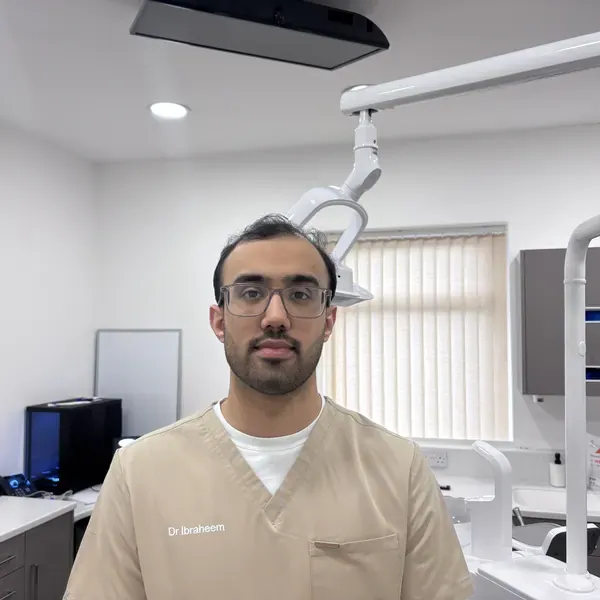 Clinically reviewed by Dr Ibraheem Ijaz, Principal Dentist · GDC 301711 · 500+ implants placed · Last reviewed August 2026
Medical disclaimer: This page is for general information only. It does not replace an examination or treatment by a dentist.
What is the dental implant failure rate in the UK?
Dental implant failure is uncommon: contemporary implants show roughly 93 to 96% survival at ten years, so around one in twenty is lost.
More precisely, a 2019 systematic review pooling 18 studies reported 10-year survival of about 96.4% at implant level, and a more cautious model that accounts for patients lost to follow-up put the figure nearer 93.2%. Both numbers describe the same reality from different angles: the great majority of implants remain in function a decade later, while the real range sits a little below the 98% figure often cited in marketing. These percentages rest on large, long-tracked datasets. The foundational Branemark implant records tracked 4,641 consecutively placed implants in nearly 900 patients from the earliest years of modern implantology, and helped establish the evidence base that today's registries and reviews build on.
It also helps to separate two words that are frequently blurred. Survival means the implant is still in place. Success is stricter: the implant is in place and the surrounding bone and gum are healthy. Survival figures always run higher than success figures, so a quoted rate only means something once you know which it is. The other essential distinction is population versus person. A pooled average blends healthy non-smokers with higher-risk patients, so the headline rate is a starting point, not a personal prediction. Patients who ask about failure rates are often really asking a different question: whether an implant is the right choice for their own situation, and that is the conversation a proper assessment is built around. The sections below break the average into the factors that actually move it. For the wider picture of the treatment itself, our how dental implants work page covers the full journey.
Why dental implants fail: early versus late failure
Dental implants fail in two distinct patterns, and the timing points to different causes.
Early failure happens before the implant has bonded to the jawbone, usually in the first weeks to months, and reflects a problem with initial healing or bone integration. This bonding process, osseointegration dental implants (when living bone grows onto the titanium surface to hold the implant firmly), is what a failing early implant has not achieved, so it stays loose and is lost. Late failure occurs after the implant has integrated and been in function, and is more often linked to progressive bone loss around the implant driven by infection or overload. The clinical consequence differs: early loss is disappointing but usually re-planned after healing, while late loss involves bone that has already formed around the fixture. Recognising the difference matters for anyone monitoring an existing implant, and the separate topic of dental implant failure signs covers what to watch for. Understanding these two mechanisms also explains why the risk factors in the next section act at different stages, some by disrupting healing, others by undermining a working implant over years.
Concerned about an implant? Call us — do not wait.
What affects the dental implant failure rate
Four factors shift dental implant failure odds most in the evidence: smoking, glycaemic control in diabetes, bone quality, and implant surface.
Smoking. This is one of the most consistently reported patient-level risks. A 2024 systematic review of 32 studies covering more than 59,000 implants found smokers had roughly two-and-a-half times the odds of early failure compared with non-smokers. Across all timepoints, a separate large meta-analysis put the overall increase at about 140% higher odds of failure. The effect is dose-related, and the encouraging counterpoint is that it is modifiable: reducing or stopping before treatment improves the outlook, and former smokers show lower risk than current smokers in the evidence. Because the framing here is balanced rather than disqualifying, the question of whether can smokers get dental implants has its own detailed answer.
Diabetes. The evidence is reassuring where control is good. Recent systematic reviews report survival of around 90 to 95% in diabetic patients whose blood sugar is well managed, comparable to non-diabetics, while poorly controlled diabetes, indicated by an HbA1c level above 8%, is linked to more bone loss and higher complication rates. Systemic health, in other words, is less about a diagnosis than about how well a condition is managed.
Bone quality. Denser bone integrates more reliably. A systematic review grouping implants by bone density found survival of 97.6% in the densest (Type I) bone falling to 88.8% in the softest (Type IV) bone, the low-density bone typically found at the back of the upper jaw.
Implant surface. Modern roughened surfaces outperform older machined ones, and the gap widens in difficult bone. In low-density bone, treated-surface implants showed about 97.1% survival against 91.6% for machined surfaces. Part of the lower survival seen in soft bone reflects these older machined designs, which modern roughened surfaces have improved on. This is a property of the surface class, not a ranking of specific brands, and no reliable head-to-head brand failure data supports comparing named systems.
In clinical practice, the factors that raise risk are usually visible before treatment begins, which is exactly why they can be planned around rather than discovered too late. An honest assessment includes whether the timing is right for you, not only whether treatment is possible at all.
How individual implant risk is assessed
Your personal implant failure risk is estimated from your own profile, not read off a national average, which is why a consultation looks at you rather than a chart.
In practice this means reviewing smoking status, any systemic conditions and how well they are controlled, and the quality and volume of bone at the intended site, then weighing those together. A non-smoker with healthy bone and no relevant medical history sits at the reassuring end of the published ranges. Someone with several stacked risk factors sits lower, though several of those factors can be addressed first. The value of the population data is precisely this: it identifies which factors to check and adjust, turning a vague worry about failure rates into a specific, manageable list. This is also why headline percentages should never be the sole basis for a decision.
Limitations of the failure-rate data
The dental implant failure figures on this page are averages drawn from research populations, so they describe groups and trends, not guarantees for any one person.
Several caveats apply. Much of the long-term data comes from older implant systems, and surfaces have improved since, which may make current real-world results better than some pooled figures suggest. Studies also vary in how they define failure and how long they follow patients, and those with the longest follow-up necessarily use the oldest technology. It is also worth setting the numbers in context: dental implants are not routinely available on the NHS and are usually provided privately, so most published outcome data comes from private and specialist care. Absolute contraindications and drug-related risks, such as certain bone medications, sit outside the scope of this statistical page and belong in an individual clinical review. Read the numbers as a well-evidenced sense of scale, not a personal forecast.
Questions, answered
Frequently asked questions
What actually counts as a failed dental implant?
A dental implant is counted as failed when it is lost, becomes mobile, or shows progressive bone loss (peri-implant disease) that cannot be brought under control. This differs from a problem with the crown on top, which can often be repaired while the implant itself stays sound and stable in the bone.
Do dental implants fail more often than crowns or bridges?
Dental implants and conventional restorations fail for different reasons over different timescales, so direct comparison is imperfect. Implants depend on bone integration, whereas bridges depend on the supporting teeth. Long-term implant survival is high in suitable patients, but the right choice depends on individual circumstances rather than a single rate.
Can a failed dental implant be replaced?
Often yes. Many sites can receive a new implant, sometimes with bone rebuilding first, though the plan depends on why the first one failed and how much bone remains. This is a clinical assessment rather than a fixed rule, and early loss is generally more straightforward to re-plan than late loss.
Does the dental implant failure rate get worse over time?
Survival does decline gradually across the years, but the fall is modest for contemporary implants. Research following patients to fifteen years still reports the large majority of implants in function. Steady maintenance and control of risk factors like smoking help keep an integrated implant stable long term.
Which patients have the highest dental implant failure risk?
Heavy smokers, people with poorly controlled diabetes, and implants placed in very soft bone show the highest rates in the evidence. Importantly these are risk factors, not automatic exclusions, and several are modifiable before treatment, which is why an individual assessment matters more than the group average.
If you have worked through the questions on this page, you likely have a clearer picture of whether a dental implant is the right direction for you. The next step is a straightforward conversation with a clinician who can assess your specific situation.
Ready when you are
Book your implant assessment.
Online in under a minute, or call and speak to a real person.