The science
Implant Abutments and Prosthetic Design: The Engineering Between Implant and Crown
This page is for patients and clinicians who want to understand the component that connects a dental implant to its crown. It explains abutment types, screw-retained and cement-retained design, emergence profile, platform switching, and the risks each choice carries. The abutment is a planned engineering decision that shapes how an implant restoration looks, cleans and lasts.
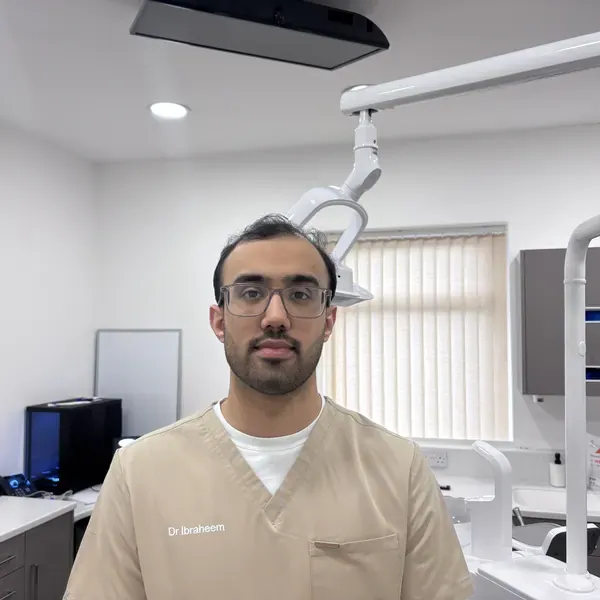 Clinically reviewed by Dr Ibraheem Ijaz, Principal Dentist · GDC 301711 · 500+ implants placed · Last reviewed August 2026
Medical disclaimer: This page is for general information only. It does not replace an examination or treatment by a dentist.
What are the different types of dental implant abutment?
Dental implant abutments, the components joining implant to crown, are grouped by fabrication method: stock, custom CAD/CAM, and titanium-base hybrid. Angled abutments are a variation within those groups. A healing abutment is a temporary component used while the site heals, not a definitive one.
A stock abutment is manufactured in advance in a fixed range of shapes, heights and angles. It is selected to suit the implant position rather than made for it. Stock abutments are widely used, and their limitation follows from being prefabricated: a standard shape can under-support the gum, or place the crown at a less than ideal angle where the implant position is demanding.
A custom abutment is designed digitally and milled for one implant in one mouth. That control matters because the abutment governs the emergence profile, the crown position and how the soft tissue is supported. A well-fitting custom titanium abutment can also correct implant angulation and produce a close interface at the implant connection.
Material choice runs across all three groups. Titanium is strong and biocompatible. Zirconia has an aesthetic advantage where the gum is thin, though umbrella review evidence found no consistent biological difference between the two materials in stock or custom form.
What is a Ti-base abutment?
A titanium-base abutment, usually shortened to Ti-base, is a prefabricated titanium interface with a ceramic superstructure bonded onto it. Its advantages run across three areas. The machined connection is matched to the implant system when the part comes from that manufacturer, the ceramic superstructure carries the aesthetic demand, and the design suits a digital workflow. Laboratory work has found that Ti-base and UCLA prefabricated components fit the connection more closely than fully digitised custom abutments, and that Ti-bases made outside the implant company can fit less well. Component provenance is therefore part of the clinical decision.
How the abutment connects the implant to the crown
The abutment sits between the implant in the bone and the crown in the mouth, secured by a screw into the implant. Almost every fixed restoration on dental implants depends on this connection, and it sits out of sight once treatment is complete.
The junction between implant and abutment is a working mechanical interface, not a passive join. It carries chewing load into the fixture and sits where bone and gum meet the restoration. Precision of fit there affects both mechanical stability and the health of the surrounding tissue. This is also where the most common mechanical complication starts. A 2023 review reports the incidence of abutment or prosthesis screw loosening at between seven and eleven per cent, a range rather than a pooled figure, since the underlying studies differ in design and follow-up. That is why abutment screw loosening as the most common mechanical issue is a maintenance event rather than a treatment failure. For how load travels through the restoration, see the biomechanical chain from crown to abutment to fixture.
When the abutment is planned during implant treatment
Abutment design is planned before the implant is placed, not chosen at the fitting appointment. Implant position dictates what the prosthetic component can achieve.
An implant placed with the final crown in mind allows a straightforward abutment and a natural emergence. An implant placed without that planning can force a compensating design later, with less control over contour and screw access. In practice the abutment is fitted after healing, once the implant has fused with the bone and an impression or scan is taken.
Implant treatment and its prosthetic components are provided privately rather than routinely on the NHS, other than in rare cases such as tooth loss after mouth cancer or trauma, so the abutment specification usually forms part of a private treatment plan. Because placement and restoration are both handled in-house at Deepcar Dental Care, the prosthetic and surgical plans are made together rather than passed between clinicians. The full treatment sequence is set out in our guide to how dental implants work.
Want this explained for your own case? Book a consultation.
Screw-retained and cement-retained restorations: the engineering trade-off
Neither retention method for an implant crown, screw-retained or cement-retained, is superior overall. High survival rates are reported for both, and the professional consensus is that no universal recommendation can be made either way.
A screw-retained restoration is held by a screw through an access channel in the crown, closed with a filling. Its advantage is retrievability, and the retrievability advantage is practical: the restoration can be removed for repair, for soft tissue inspection and for direct view of the implant, then refitted without being remade.
Its trade-off is mechanical: some reviews report prosthetic complications, screw loosening in particular, more often for screw-retained restorations. A systematic review of 23 studies pooled minor complications across both retention types at 3.66 screw loosenings and 2.54 decementations per 100 years of service. That is a rate measure, not a lifespan, and decementation is a cement-retained event. On the major outcomes, implant survival and crown loss, the same review found no significant difference between the methods.
A cement-retained restoration is fixed to the abutment with dental cement. It gives an uninterrupted crown surface, which is why it is recommended where the screw access channel would emerge through a visible surface of the crown, or where implant malposition makes screw retention unaesthetic. The risk it carries is cement left in the tissue below the crown margin.
The evidence diverges. One meta-analysis of 20 studies covering 8,989 implants favoured cement retention on marginal bone loss by about 0.19 mm, which the authors noted may not be clinically significant, and on implant survival. A 2025 meta-analysis of single zirconia crowns found screw-retained restorations carried a 46 per cent lower risk of complications. Retention is selected per case on implant angulation, aesthetics and access. Guidance on choosing between crown types is covered on our page about implant crown types.
Emergence profile and platform switching in abutment design
Emergence profile is the contour of the abutment and crown as it passes through the gum, and it has a measurable effect on peri-implant health.
A cross-sectional analysis of 168 implants followed for a mean of almost eleven years found peri-implantitis, inflammation with bone loss around an implant, in 31.3 per cent of bone-level implants with an emergence angle above 30 degrees, against 15.1 per cent at 30 degrees or less. Where a convex profile was combined with a wide angle, prevalence reached 37.8 per cent. The same association was not found in tissue-level implants. The design response for bone-level implants is a shallower angle with a straight or concave profile between the teeth, which also leaves a shape the patient can clean around.
Platform switching is the deliberate use of an abutment narrower than the implant platform, shifting the implant-abutment junction inward. Meta-analyses comparing platform-switched with platform-matched implants report marginal bone loss reductions of roughly 0.37 to 0.41 mm, with the degree of preservation related to the size of the mismatch. The same reviews found no significant difference in implant failure rates, so platform switching is best understood as bone-level preservation rather than a survival mechanism. Because a narrower platform can widen the restoration's contour, emergence angle and platform switching must be planned together.
Few patients ask about the abutment by name. They ask why one implant restoration looks and cleans like a natural tooth while another does not, and the answer often sits in this component.
Want this explained for your own case? Book a consultation.
Risks and limitations of abutment and prosthetic design
The principal design-dependent biological risk is cement left below the gum, and the mechanical one is screw loosening.
Residual cement is difficult to detect and remove. A clinical study of 53 single implants found that the deeper the cementation margin, the more undetected cement remained, and that radiographs identified visible remnants in only around 7.5 per cent of cases mesially and 11.3 per cent distally. An observational study reported cement residue in roughly 60 per cent of subgingival margin cases against 24 per cent supragingival, a 3.66-fold higher risk. Keeping the abutment finish line at gingival level, where aesthetics allow, limits residual cement.
Two endoscopic studies of patients presenting with peri-implant disease, inflammation around an implant, found residual cement in roughly 80 per cent of those patients. Both sampled patients who already had the disease, so the figure describes an association within an affected group rather than how often the problem occurs across all implants. Screw retention removes the cement variable but not the maintenance requirement. No abutment design removes the need for cleaning and review.
In clinical practice these risks are decided at the design stage, not the fitting appointment. Where the margin sits, how the profile is shaped and how the restoration will be retrieved are settled before anything is made.
Questions, answered
Frequently asked questions
Can an abutment be changed after the crown is fitted?
Yes, an abutment can be replaced, though the work involved depends on how the crown is retained. A screw-retained crown is removed and refitted. A cemented crown usually has to be sectioned and remade, so the abutment beneath is reached at the cost of the restoration above.
Is a custom abutment worth the extra cost over a stock one?
Whether a custom abutment justifies its extra cost depends on the site rather than on price alone. Short-term trial evidence favours custom abutments on soft tissue and aesthetic measures, while a 2023 study found no significant difference in anterior sites. The benefit is clearest in demanding positions.
Does a zirconia abutment look better than titanium?
Zirconia can look better where the gum is thin, because titanium may cast a grey shadow through thin tissue. The decision belongs to the treating clinician and is made at planning, once the implant position and gum thickness are known, rather than at the fitting appointment.
What happens if the abutment screw keeps loosening?
Repeated loosening usually points to a mechanical cause rather than a faulty screw. Patients tend to ask after a second retightening, and the repetition is itself the signal. Accuracy of fit at the interface is one documented variable, and how the restoration is loaded is another. The answer is assessment, not another retighten.
Do all implant systems use the same abutments?
No, abutment connections are system-specific to the implant they sit on. This matters years later, because a replacement restoration has to be matched to the original implant fixture, so the system used should be recorded at the time and kept with your treatment notes.
Is the abutment placed at the same time as the implant?
Not usually in a conventional protocol. A healing abutment may be fitted to shape the gum while the site heals, with the definitive abutment and crown made afterwards from an impression or scan. Timing depends on the case and is planned in advance.
Dr Ibraheem Ijaz holds a PG Diploma in Implant Dentistry and has placed and restored more than 500 implants at Deepcar Dental Care since 2022, handling placement and restoration in-house. Contact Deepcar Dental Care to arrange a consultation.
Ready when you are
Book your implant assessment.
Online in under a minute, or call and speak to a real person.