Treatment
Implant Crown Types — Screw-Retained vs Cement-Retained
This page is for patients choosing between implant crown options. It explains how screw-retained and cement-retained crowns differ, when zirconia or porcelain-fused-to-metal is selected, and what each choice means for appearance and future maintenance. The right combination depends on where the implant sits and what matters most to you.
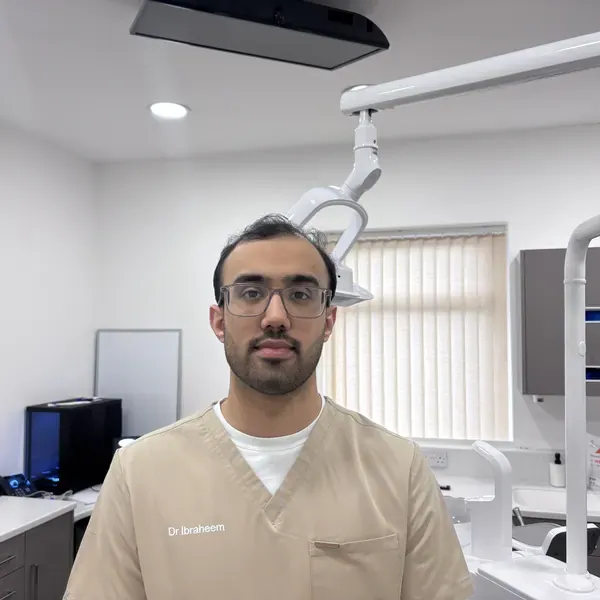 Clinically reviewed by Dr Ibraheem Ijaz, Principal Dentist · GDC 301711 · 500+ implants placed · Last reviewed August 2026
Medical disclaimer: This page is for general information only. It does not replace an examination or treatment by a dentist.
What is an implant crown?
An implant crown is the visible tooth-shaped restoration attached to the top of a dental implant. It is the part of the implant you see, eat with, and brush every day. The implant fixture itself sits hidden in the jawbone, and a small connector called an abutment links the fixture to the crown on top.
In practice, dental implant crown options come down to two decisions. The first is the retention method: whether the crown is held in place by a small screw or by dental cement. The second is the material: most commonly zirconia, a high-strength tooth-coloured ceramic, or porcelain-fused-to-metal (PFM), where a metal core is covered with a porcelain outer layer. Each combination carries trade-offs, and the right choice depends on where the implant is in the mouth and what matters most to you.
Many patients who enquire about implant crowns are not just asking what they are. They want to know whether their case will benefit more from one combination of retention and material than another. The decision is rarely about which option is best in the abstract; it is about which suits the specific implant position, the bite, and the aesthetic that matters most.
How a screw-retained implant crown is fixed
A screw-retained crown is held to the implant by a small retaining screw passing through the biting surface. The screw is tightened to a specific torque, and the resulting access channel is then sealed with a tooth-coloured composite filling. From the outside, the channel is normally invisible.
The main practical advantage is retrievability. If a future repair, replacement, or routine maintenance is needed, the access channel can be reopened, the screw loosened, and the crown lifted off without destroying the restoration. In many cases, problems can be addressed without remaking the crown.
The main consideration is angulation. The screw access has to emerge somewhere, and on a front tooth that point needs to be on the palatal side rather than the visible face. Modern angulated screw channel systems (which allow the screw access to emerge at an angle off the crown’s central axis) have widened the range of cases where screw retention can still be used in the aesthetic zone. Where an implant has been placed with prosthetics in mind from the planning stage, screw retention is often the default.
How a cement-retained implant crown is fixed
A cement-retained crown is luted to a separate abutment using dental cement, in the same way a conventional crown is bonded onto a natural tooth. The abutment is screwed into the implant first, and the crown is then cemented onto the abutment.
Because there is no access channel through the biting surface, a cement-retained crown can offer slightly cleaner aesthetics on a difficult front tooth, particularly where the implant angulation would otherwise place a visible composite filling on the labial surface. It also gives the dental laboratory more freedom in shaping the porcelain layer.
The trade-off is removal. A cemented crown is, in normal circumstances, fixed for the life of the restoration and cannot usually be taken off without sectioning the crown itself. There is also a recognised clinical concern about excess cement: if any luting material is left beneath the gumline during seating, it can become a long-term irritant for the surrounding tissues. For deeper reading on the underlying components, see our page on sub-gingival cement risk and why screw retention avoids it.
Zirconia vs porcelain-fused-to-metal: which material suits which case
Zirconia is a high-strength tooth-coloured ceramic with no metal core; porcelain-fused-to-metal (PFM) crowns use a metal substructure veneered with porcelain. Both produce a natural-looking result, but they behave differently at the margins and over time.
Zirconia offers a uniformly tooth-coloured substrate. With nothing metallic underneath, there is no risk of a grey shadow showing through thin gum tissue or a visible metal collar at the gumline if recession occurs in later years. For patients with a thin gingival biotype (a naturally thin layer of gum tissue at the gumline) or a high smile line, this can matter aesthetically. Monolithic zirconia, where the crown is milled from a single block, is also more resistant to the chipping that veneered ceramics can experience.
PFM crowns have decades of clinical track record. They are robust, well-understood, and remain a reasonable choice for posterior teeth where appearance is less critical and where opposing teeth or grinding habits make ceramic chipping a concern. The known compromise is the metal core: if the gum recedes over many years, a thin grey margin can sometimes become visible.
For most aesthetic-zone implant crowns today, zirconia, often layered with porcelain only on the visible surface, is the more common selection. For molars, both materials remain reasonable, and the decision rests on the bite, the opposing dentition, and the laboratory’s recommendation.
Ask whether this treatment fits your case.
When each retention type is used
Screw-retained implant crowns are generally preferred where implant position allows; cement-retained crowns are reserved for cases where it does not. The decision is normally made at the planning stage, before the implant is placed.
In posterior teeth, molars and premolars, screw retention is typically the default. There is space to place the screw access on a non-visible surface, retrievability is straightforward, and the small risk associated with sub-gingival cement is avoided entirely. When the procedure for replacing one missing tooth with an implant is planned correctly from the start, screw retention is usually achievable in straightforward posterior cases.
In the anterior aesthetic zone, the decision is more nuanced. If the implant has been placed with the screw access channel angled toward the palatal side, screw retention is again preferable. If the implant axis runs straight through the labial face, cement retention may be chosen so that the front of the crown can be left as uninterrupted porcelain. Angulated screw channel systems have shifted many of these cases back toward screw retention in recent years, but not all.
A clinician’s job is to anticipate this question before the implant is surgically placed in the bone. Where placement is prosthetically driven from the start, screw retention is usually achievable, and the future maintenance picture is simpler.
Risks, limitations, and long-term considerations
The main risks are mechanical for screw-retained crowns and biological for cement-retained crowns, with both methods well-documented in published clinical evidence.
For screw-retained crowns, the most common complication is the screw working slightly loose over time, particularly under heavy biting load. The fix is usually straightforward: the composite seal is removed, the screw is retightened to its correct torque, and the seal is replaced, typically in a short appointment. Minor chipping of the surrounding composite is also a known finding. Both issues are manageable precisely because the crown is retrievable.
For cement-retained crowns, the recognised long-term concern is residual sub-gingival cement and its link to peri-implant disease (inflammation of the soft tissue and bone around an implant). A prospective endoscopic study by Wilson in 2009, examining 39 consecutive patients with signs of peri-implant disease, found that clinical or radiographic signs were absent in around three-quarters of implants after excess cement was removed, consistent with excess cement being a major contributing factor in the cases examined. A 2025 systematic review and meta-analysis by Tomar and colleagues (Cureus, 2025) of cement- versus screw-retained zirconia single crowns reported similar marginal bone loss between the two methods, with biological complications more common around cement-retained restorations and minor technical issues more common around screw-retained ones.
Material-specific limitations also apply. Zirconia crowns can chip if the bite is heavy or if the patient grinds at night without protection; PFM crowns can show a grey margin if the gum recedes over many years. A well-planned crown accounts for these factors before the laboratory begins fabrication.
In day-to-day implant practice, the issues that come up around implant crowns are usually mechanical and minor rather than failures of the implant itself. Screw loosening, small composite chipping at the access seal, or a cemented crown that needs recementing are all routine to manage at a maintenance review. Patients who notice any change in how their crown feels or looks are encouraged to raise it at the earliest opportunity; the earlier a small issue is reviewed, the more straightforward the fix tends to be.
Caring for your implant crown
Implant crowns are cleaned with the same daily brushing routine as natural teeth, supported by interdental brushes or floss around the implant collar. The aim is to remove plaque without traumatising the soft tissue at the gumline.
Some patients find a water flosser useful for cleaning around the gum margin where the crown meets the gum. The tissue at an implant collar is more vulnerable to inflammation than the gum around a natural tooth root, so consistent home cleaning matters. Regular professional reviews, usually every six months, monitor the implant, the crown, and the surrounding gum tissue.
Ask whether this treatment fits your case.
How much does an implant crown cost?
Implant crown costs vary by material, retention method, and the complexity of the underlying case. Zirconia and PFM crowns sit broadly within the same private fee range, with screw and cement retention also priced similarly for routine cases.
What changes the figure is what surrounds the crown: the implant fixture itself, any abutment customisation, and any additional work such as bone grafting or soft tissue management. For most patients, the crown is one cost line within an overall treatment plan rather than a standalone purchase. Private implant crowns at Deepcar Dental Care are provided with a guarantee policy, with the specific terms confirmed during your consultation. Patients can review the full cost breakdown for dental implants in the UK on our cost page, which sets out what is typically included in a private implant quote.
Implant treatment is not routinely available on the NHS in England; funding is reserved for exceptional clinical need such as after head and neck cancer treatment, severe trauma, or congenital tooth absence, and is delivered through specialist hospital services. The current NHS Band 3 charge in England (£332.10 from 1 April 2026) applies to crowns provided on the NHS in the routine bands but does not extend to private implant crowns. Most patients pursuing implant treatment access it privately in the UK.
Speak to Dr Ibraheem Ijaz about your implant crown
Call 0114 288 2121 to arrange an implant assessment with Dr Ibraheem Ijaz at Deepcar Dental Care.
If you are weighing the trade-offs between screw-retained and cement-retained crowns, the next step is a conversation with a clinician who can assess the specific implant position, your bite, and your aesthetic priorities. For most patients, the retention and material decision is best made before the implant is surgically placed, rather than after.
Dr Ibraheem Ijaz handles both the surgical placement and the final crown at Deepcar Dental Care, and has placed and restored more than 500 implants since beginning implant placement in 2022. This single-clinician pathway means the position of the implant, the choice of abutment, and the retention method of the crown are all planned as one continuous treatment from the first consultation onward.
At follow-up, patients commonly report that what helped most was having the trade-offs of each option laid out clearly during planning. To talk through your case, see Deepcar Dental Care implant services on our main treatment page, or speak to our team on 0114 288 2121.
Questions, answered
Frequently asked questions
Can a screw-retained crown be changed to a cement-retained one later?
In principle, yes, but it usually requires a new restoration rather than a modification of the existing one. The retention method is normally decided before the crown is made, with the implant’s angulation guiding which approach will work best in the long term. Switching after fabrication is uncommon in routine cases.
Are zirconia implant crowns better than porcelain-fused-to-metal?
Neither material is universally better; the right choice depends on the tooth’s position, the patient’s bite, and aesthetic priorities. Zirconia avoids any metal at the gum margin and works well in the aesthetic zone. PFM has a long clinical track record and remains a reasonable choice for posterior teeth where chipping resistance matters most.
How long do implant crowns last?
Implant crowns are designed for long-term use. Five-year clinical studies and systematic reviews typically report survival outcomes comparable to crowns on natural teeth, with longer-term data continuing to accumulate. Actual longevity depends on bite force, oral hygiene, regular professional reviews, and whether the underlying implant fixture remains stable.
Will the screw access hole show on a screw-retained crown?
Normally, no. The access channel is sealed with a tooth-coloured composite filling colour-matched to the surrounding ceramic. On most teeth the channel exits on a non-visible surface, and on front teeth contemporary angulated channel designs often allow the access to exit on the palatal side, out of sight from the front.
Why do some dentists prefer screw-retained crowns?
Many clinicians prefer screw retention where implant angulation allows because the crown is retrievable for future maintenance and there is no cement involved. Residual sub-gingival cement is a recognised risk indicator for peri-implant disease, so eliminating cement removes that specific risk pathway entirely from the long-term picture.
What happens if an implant crown chips or comes loose?
A loose screw-retained crown can usually have its access channel reopened and the screw retightened in one short appointment. A debonded cement-retained crown is recemented or remade. Minor ceramic chipping can sometimes be polished and refinished; larger fractures normally need the crown remaking by the laboratory.
Ready when you are
Book your implant assessment.
Online in under a minute, or call and speak to a real person.