The science
Titanium vs Zirconia Dental Implants: Which Material Is Right for You?
This page is for anyone comparing titanium and zirconia dental implants and unsure which material suits them. It explains how the two differ in strength, aesthetics, biocompatibility, design and cost, using published clinical evidence rather than product claims. Core takeaway: both are proven materials with different trade-offs, and the right choice depends on your individual site, gums, bite and preference, confirmed at clinical assessment.
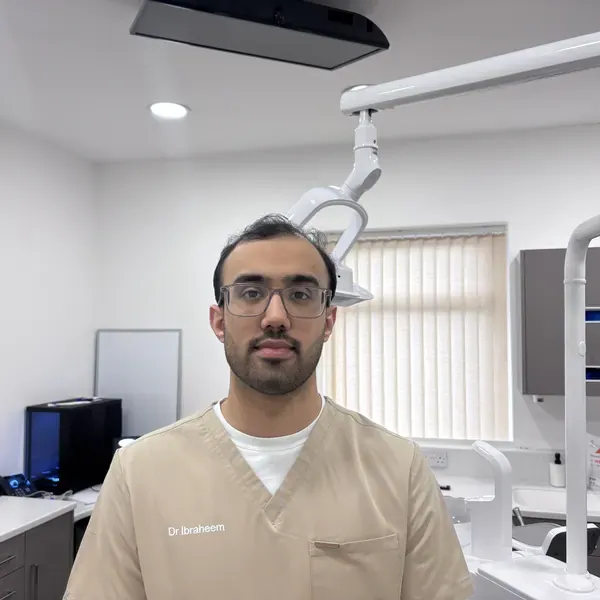 Clinically reviewed by Dr Ibraheem Ijaz, Principal Dentist · GDC 301711 · 500+ implants placed · Last reviewed August 2026
Medical disclaimer: This page is for general information only. It does not replace an examination or treatment by a dentist.
The key differences at a glance
Titanium and zirconia are both used to replace missing teeth, but they differ most in track record, aesthetics and design flexibility.
Clinical track record — Titanium: ~50+ years of use with extensive long-term data. Zirconia: newer, with more limited 10-year-plus data.
Aesthetics — Titanium: grey metal can show through very thin gums. Zirconia: tooth-coloured and favoured for thin gum biotypes.
Biocompatibility — Titanium: high, with hypersensitivity rare. Zirconia: metal-free fixture that avoids titanium-ion exposure.
Design — Titanium: available as two-piece for angulation flexibility. Zirconia: historically one-piece, with two-piece systems now emerging.
Strength behaviour — Titanium: a ductile metal that resists fracture well. Zirconia: hard but brittle, with high flexural strength.
Long-term evidence — Titanium: long, consistent multi-year survival data. Zirconia: promising but more heterogeneous, over shorter follow-up.
Typical cost — Titanium: usually the lower-cost option. Zirconia: often priced at a premium.
In the closest like-for-like comparison, two randomised controlled trials found no statistically significant difference in survival between zirconia and titanium at 12 months. No single column wins every row, which is why material selection is individual rather than universal.
Titanium dental implants — what you need to know
Titanium is the longest-established implant material, valued for its strength, biocompatibility and decades of clinical data.
Most titanium fixtures are made from commercially pure titanium, and grade 4 is the highest-strength of the commercially pure grades. As a metal, titanium is ductile, so it tends to resist fracture well under bite forces. Longer-term figures cited in a 2023 systematic review put titanium survival in the region of 97 percent at five years and 95 percent at ten years, drawn from earlier cohort data; survival reflects the whole system and aftercare, not the metal grade alone.
Surface treatment matters as much as the metal. A sandblasted, large-grit, acid-etched (SLA) surface roughens the titanium to encourage bone contact, and a chemically modified hydrophilic version (SLActive) shows greater bone-to-implant contact in early-healing studies, with the surfaces converging by around eight weeks. Both materials still rely on the same biological process to bond with bone, which you can read about in our explainer on how implants fuse with bone.
On allergy: titanium hypersensitivity is rare but clinically relevant. Studies report a positive reaction in roughly 0.6 percent of patients on epicutaneous (patch) testing, and figures may be underreported. For most people titanium is well tolerated, and a metal-allergy history is something a clinician can assess before treatment. Brand selection interacts with material too, which we cover in our guide to the best dental implant brands in the UK.
Want this explained for your own case? Book a consultation.
Zirconia dental implants — what you need to know
Zirconia is a tooth-coloured ceramic implant material chosen mainly for aesthetics and as a metal-free alternative to titanium.
Modern zirconia implants are usually made from yttria-stabilised tetragonal zirconia polycrystals (Y-TZP), often at 3 mol percent yttria (3Y-TZP), a form with a reported flexural strength above 900 MPa. Zirconia resists cracks through a phase-transformation toughening mechanism, where a small structural change at a crack tip helps blunt it. The same chemistry makes zirconia susceptible to slow low-temperature degradation, sometimes called ageing, which is one reason long-term data is still building.
Design is a practical difference. Many zirconia systems are one-piece, with the fixture and abutment integrated, which limits how much the angle can be corrected during restoration; two-piece zirconia systems are now emerging to address this. Because zirconia is hard but brittle, it can fracture under heavy load despite its high flexural strength, and across systematic reviews its survival figures vary more widely than titanium, partly because studies mix implant positions and one- and two-piece designs.
In clinical practice, zirconia questions most often come from patients focused on a visible front tooth or a metal-free preference, and those priorities are worth weighing alongside the material's limitations.
The term 'metal-free' refers to the absence of a metal fixture, not the absence of any manufacturing limitation. Zirconia's genuine strengths are its natural shade, which suits patients with thin gums, and its low plaque affinity reported in comparative reviews. If you are replacing a visible front tooth, aesthetics often carry more weight, and you can see how a single restoration is planned on our single tooth implant page.
Which material suits which patient?
Material choice depends on the site, gum thickness, bite forces, aesthetic priority and personal preference, not a single rule.
In practice, most patients asking about titanium versus zirconia are not really asking which is stronger on paper; they want to know which one fits their own mouth and their own priorities.
The following patterns are general guidance, not a recommendation for any individual:
• If aesthetics in a highly visible zone with very thin gums are the priority, zirconia may be more suitable because its tooth-coloured ceramic avoids grey show-through.
• Where a genuine metal sensitivity is confirmed, a metal-free zirconia option may be considered, though true titanium allergy is rare.
• If the site needs angulation correction or complex prosthetic work, titanium's two-piece designs may be more flexible.
• For patients who value the longest possible evidence base and predictable fracture behaviour, titanium's track record is more established.
• Where cost is the deciding factor, titanium is usually the lower-cost option.
Because these factors interact, the honest answer for most patients is that the material is chosen together with a clinician after assessing the specific gap. Many patients at Deepcar Dental Care find that once the trade-offs are laid out plainly, the decision becomes clearer than they expected.
How much do titanium and zirconia implants cost in Sheffield?
Zirconia implants are typically priced at a premium over titanium, though exact figures depend on your individual case.
Cost reflects the material, the components, the surgical planning and the restoration, so a single tooth differs from a more complex case. Rather than quote figures that may date, you can see current ranges on our dental implant cost page and discuss your own case at consultation. Dental implants are only available on the NHS in limited clinical circumstances, so most patients access treatment privately. A full picture of the treatment itself is set out in our complete guide to dental implants.
Questions, answered
Frequently asked questions
Are zirconia implants better than titanium?
Neither material is universally better; each has trade-offs. Titanium offers the longest track record, more design flexibility and usually lower cost. Zirconia offers tooth-coloured aesthetics and a metal-free option that can suit thin gums. The right choice depends on your specific site and is decided at clinical assessment.
Are titanium dental implants safe if I have a metal allergy?
Titanium hypersensitivity is rare, affecting roughly 0.6 percent of patients on patch testing, though it is clinically relevant when present. Most people with general metal sensitivities tolerate titanium well. If you have a known allergy history, tell your clinician, who can assess it and discuss whether a metal-free zirconia option is appropriate for you.
Do zirconia implants fracture more easily than titanium?
Zirconia is hard but brittle, while titanium is a ductile metal that bends before it breaks. Modern 3 mol percent zirconia (3Y-TZP) has a reported flexural strength above 900 MPa and performs well in many cases, but its fracture behaviour under heavy load is still debated in the literature. A clinician weighs this against the site and bite.
What does a 'metal-free' dental implant actually mean?
'Metal-free' means the implant fixture is ceramic rather than metal, so no titanium is used in the screw itself. It does not imply the material is limitation-free. Zirconia avoids metal ions and grey show-through, which some patients prefer, but has its own considerations around long-term data and prosthetic flexibility.
Are zirconia implants available in the UK?
Yes, zirconia implants are available in the UK as a metal-free alternative to titanium, offered by practices with ceramic implant systems. Availability of specific designs, particularly two-piece zirconia, varies between practices. A consultation with an implant dentist confirms whether a zirconia option is suitable for your individual case.
Ready when you are
The next step
If you have worked through the trade-offs on this page, you likely have a clearer picture of which material direction fits you. The next step is a conversation with a clinician who can assess your specific site, gums and bite.