Treatment
All-on-4 Dental Implants — Full Arch on Four Implants at Deepcar Dental Care
This page is for people considering All-on-4 to replace a full arch of missing or failing teeth. It explains how four implants support a fixed bridge, who the treatment suits, what happens on the day of surgery, indicative costs at our Sheffield practice, and how All-on-4 compares to All-on-6.
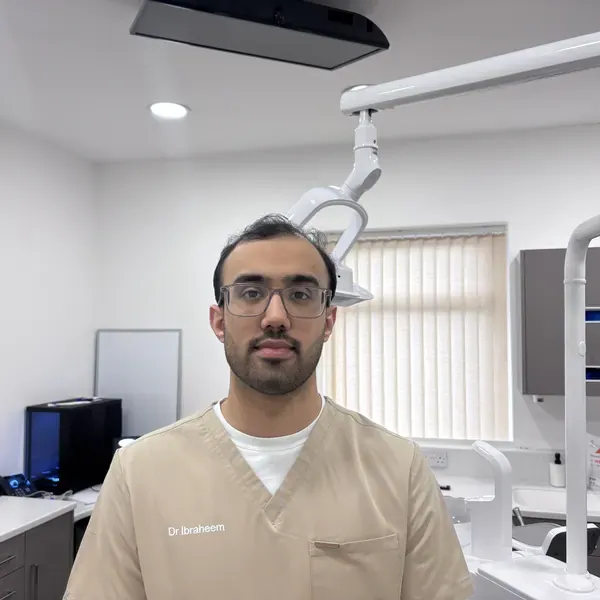 Clinically reviewed by Dr Ibraheem Ijaz, Principal Dentist · GDC 301711 · 500+ implants placed · Last reviewed August 2026
Medical disclaimer: This page is for general information only. It does not replace an examination or treatment by a dentist.
What are All-on-4 dental implants?
All-on-4 is a full-arch treatment that replaces all teeth in one jaw using four dental implants to support a single fixed bridge. The concept was developed by Dr Paulo Maló and first published in 2003, building on earlier work in tilted-implant protocols, to rehabilitate jaws that have lost bone volume without the routine need for bone grafting. Two implants are placed vertically in the front of the jaw, where bone density is usually highest, and two are placed at an angle toward the back — typically between 30° and 45°. This angulation maximises contact with available bone and avoids the maxillary sinus in the upper jaw and the inferior alveolar nerve in the lower jaw. The four implants then support a fixed, non-removable bridge, often delivered on the same day as surgery. Many patients who enquire about All-on-4 are not only asking what it is — they want to know whether it is right for their specific situation, what the day of surgery actually involves, and how soon they can return to eating and speaking normally. For a broader overview of implant options, you can explore our full dental implants treatment types overview.
How the All-on-4 procedure works — tilted implants and immediate loading
The All-on-4 procedure places four implants in strategic positions and loads them with a provisional fixed bridge on the same day. This immediate-loading protocol is what some clinicians refer to as “teeth in a day” — though the teeth fitted on the day of surgery are a provisional fixed bridge, not the definitive restoration. The tilted placement of the posterior implants increases the anterior-posterior (AP) spread, which distributes biting forces more evenly across the arch and reduces the length of the prosthetic cantilever — the unsupported section of the bridge that extends beyond the last implant. Systematic review evidence (Soto-Penaloza et al., J Clin Exp Dent 2017) reports that insertion torque for immediate loading typically falls between 30 and 50 Ncm to achieve the primary stability the provisional bridge requires. The provisional bridge is acrylic and is designed for function and appearance during the healing period, not as a lifetime restoration. A definitive bridge — typically in monolithic zirconia, ceramic, or an acrylic-metal hybrid construction — is fitted several months later, once the implants have integrated with the bone. At Deepcar Dental Care, implants used for All-on-4 are drawn from established systems including Straumann, Nobel Biocare, and Neodent, chosen for long-term part availability and published clinical evidence. The biomechanics of why four angled implants can reliably support a full arch are explained in more detail on our implant biomechanics page.
Who is a suitable candidate for All-on-4?
All-on-4 typically suits patients who have lost or will soon lose all teeth in one jaw and want fixed teeth rather than dentures. Ideal candidates have enough bone in the anterior jaw to stabilise the axial implants and enough posterior ridge to anchor the tilted implants, reasonable general health, and no active gum disease or untreated decay. Well-managed medical conditions — including controlled diabetes, stable osteoporosis, and oral bisphosphonate use — do not automatically rule a person out, but they do require careful individual assessment. Active smoking, uncontrolled diabetes, current intravenous bisphosphonate therapy, recent head-and-neck radiotherapy, and severe untreated periodontal disease are all factors that may defer or modify treatment. At Deepcar Dental Care, candidacy is confirmed through an implant consultation, a CBCT (Cone Beam Computed Tomography) scan, and a full medical history review before any treatment plan is issued.
Ask whether this treatment fits your case.
What to expect — from consultation to fixed bridge
The All-on-4 treatment pathway runs from initial consultation through to final bridge delivery over approximately four to six months. The first appointment is a clinical examination and discussion of your situation, followed by a CBCT scan that produces a three-dimensional map of the jawbone used for digital planning. On the day of surgery, any remaining failing teeth are removed, the four implants are placed under local anaesthetic (conscious sedation is available), and — where primary stability allows — patients leave the practice the same day with a fixed provisional bridge rather than a removable denture. Over the following weeks, soft tissues heal and the implants integrate with the bone. Review appointments monitor healing, and the definitive bridge is fitted once integration is confirmed. Patients often describe All-on-4 surgery as more comfortable than they had anticipated — a theme that appears in our patient reviews.
How much does All-on-4 cost at Deepcar Dental Care?
All-on-4 at Deepcar Dental Care starts from £12,000 per jaw and £20,000 for both jaws, with final costs confirmed after clinical assessment. The fee covers the surgical placement of four implants and the fixed bridge; the denture or final prosthesis is quoted separately, as shown on our fee guide. An implant consultation is £100 and a CBCT implant scan is £150, with the consultation fee credited against treatment cost if you proceed. Finance is available through Tabeo Finance Ltd (authorised and regulated by the FCA, registration 777539) — options include up to 18 months interest-free and up to 60 months at 10.9% APR representative, subject to status. For a detailed cost breakdown and what is included at each stage, see the full cost breakdown for All-on-4 treatment in the UK.
Ask whether this treatment fits your case.
All-on-4 vs All-on-6: which is right for you?
All-on-4 uses four implants to support a full-arch bridge; All-on-6 uses six. The right choice depends on jaw anatomy, bone quality, and bite forces — not on a blanket rule. Recent clinical evidence, including a 2025 retrospective study of 943 patients and 5,989 implants (J Clin Med 2025), reports that two- and five-year implant survival rates for immediately loaded four- and six-implant full arches are comparable when the treatment plan is anatomy-driven. A separate 2024 systematic review and meta-analysis of 53 included studies found no significant difference in implant and prosthesis survival or complication rates between four- and six-implant maxillary restorations, though it noted that marginal bone loss may be higher in some four-implant maxillary configurations. In practice, All-on-6 is often considered when the upper jaw has adequate bone volume distributed across the arch, while All-on-4 is well-suited to atrophic jaws where grafting would otherwise be needed.
Risks, limitations, and long-term maintenance
The main risks of All-on-4 are biological — such as peri-implantitis and marginal bone loss — and mechanical, such as wear or fracture of the bridge and loose prosthetic screws. Biological complications — including peri-implantitis (inflammation of the tissue around an implant with progressive bone loss), soft-tissue inflammation, and marginal bone loss — are reported in a minority of patients in long-term follow-up studies, and the risk increases with poor daily hygiene, smoking, and uncontrolled systemic disease. Mechanical complications are more common than biological complications but are generally repairable without removing the implants themselves. In clinical practice, when complications do arise they most commonly surface during the early healing period and are usually linked to hygiene habits, smoking, or a medical factor that was identifiable at assessment, rather than to the implants themselves. Most are manageable when picked up at a routine review. Smoking roughly doubles the relative risk of implant failure compared with non-smokers (PLOS ONE meta-analysis, 2013, >40,000 implants). Long-term success depends on thorough daily cleaning, regular hygiene appointments, and ongoing clinical review. Documented full-arch cases at our practice can be viewed on our full arch implants case study page.
Questions, answered
Frequently asked questions
How long does All-on-4 treatment take from start to finish?
The full pathway typically spans four to six months, from consultation to the definitive bridge. Surgery itself is usually completed in a single day, with a fixed provisional bridge fitted the same day where primary stability allows. The definitive bridge is placed once the implants have integrated with the bone.
Will I be left without teeth at any point during treatment?
No. The All-on-4 protocol is designed specifically to avoid this. On the day of surgery, a fixed provisional bridge is attached to the four implants before you leave the practice, provided primary stability is adequate. You will wear fixed teeth — not a removable denture — throughout the healing period until the definitive bridge is fitted.
Can I have All-on-4 if I have been told I need a bone graft?
Patients often ask this after being told elsewhere that grafting is essential — the answer depends on anatomy, not a single rule. All-on-4 was developed to make full-arch treatment possible in jaws with reduced bone, because the tilted posterior implants anchor into denser bone further forward. Whether grafting is still needed depends on your individual CBCT (3D jaw) scan findings, assessed at consultation.
Are All-on-4 teeth permanent, or will they need replacing?
Patients often ask this because implants and bridges are different components with different lifespans — and online sources sometimes blur the two. The titanium implants are designed to remain in place long-term, with published studies reporting high survival over 10+ years. The bridge itself is a wearing part — the provisional is replaced, and the definitive bridge may need refurbishment over time.
Is All-on-4 available on the NHS?
All-on-4 is not routinely available on the NHS. NHS-funded implant provision is reserved for specific Royal College of Surgeons of England priority groups — including severe denture intolerance with significant bone loss, congenital tooth absence, tooth loss through trauma, and reconstruction after cancer treatment or major jaw surgery. Most patients seeking All-on-4 access treatment privately — information on how implants compare to removable options is covered on our dental implants vs dentures pros and cons page.
Ready when you are
The next step
Book a consultation with Dr Ibraheem Ijaz to find out whether All-on-4 suits you. If you have worked through the information on this All-on-4 page, you likely have a clearer picture of whether the treatment is the right direction for your situation.