Comparing your options
Dental Implants vs Dentures — A Deep Comparison
This page is for adults weighing dental implants against removable dentures to replace missing teeth. It compares 20-year cost, bone preservation, chewing function, aesthetics and quality of life. The short answer: the right choice depends on your bone, health, budget and priorities — not on which option is “better” in isolation.
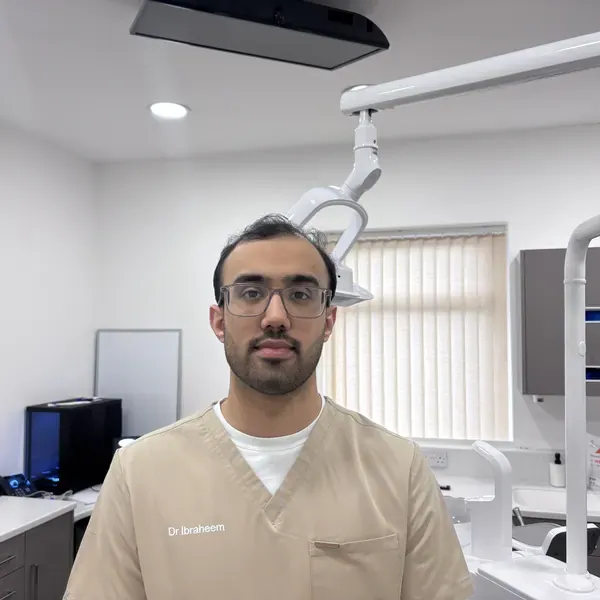 Clinically reviewed by Dr Ibraheem Ijaz, Principal Dentist · GDC 301711 · 500+ implants placed · Last reviewed August 2026
Medical disclaimer: This page is for general information only. It does not replace an examination or treatment by a dentist.
The key differences at a glance
Dental implants are fixed titanium fixtures in the jawbone, while removable dentures are appliances that rest on the gums — they differ on cost, longevity, bone, function and NHS availability.
| Dimension | Dental implants | Removable dentures |
|---|---|---|
| Type | Fixed titanium fixture in the jawbone with a crown, bridge or arch on top | Removable acrylic appliance (full or partial) resting on gums |
| Upfront cost | From £2,400 per implant at Deepcar (plus consultation and CBCT) | Lower upfront — NHS Band 3 charge covers a full denture where eligible (check the current NHS dental charge, reviewed annually) |
| Longevity | Fixture can last many years with maintenance; systematic review evidence commonly reports high survival rates at 10 years | Typically need relines, adjustments or remakes over the years as the jawbone changes shape |
| Bone preservation | Transmit bite force to bone, helping to preserve the jawbone | Do not load bone; associated with ongoing alveolar ridge resorption |
| Chewing function | Close to natural teeth once healed | Reduced bite force, particularly with lower complete dentures |
| Aesthetics | Crown emerges from the gum like a natural tooth, with controlled emergence profile | Can look natural, but acrylic bulk and metal clasps may be visible depending on design |
| Maintenance | Brush, interdental clean, regular hygienist visits | Daily removal and cleaning; soak overnight; replace when worn |
| NHS availability | Not routinely available | Available on NHS Band 3 for eligible patients |
No column wins every row. Implants lead on function, bone and longevity; dentures lead on upfront cost, speed of fitting and NHS accessibility.
Dental implants — what you need to know
A dental implant is a titanium screw placed into the jawbone that fuses with bone over several months and then carries a crown, bridge or full-arch restoration. Once integrated, a dental implant functions closely to a natural tooth root, transmitting bite force to the jawbone the way your own teeth did.
Many patients who enquire about dental implants are not just asking what they are — they want to know whether implants are the right answer for their specific situation, given their age, bone, budget and how they feel about surgery. That is a clinical conversation, not a web-page conversation, which is why everything below is framed as information to bring to a consultation rather than a verdict.
The clinical evidence on implants is among the strongest in dentistry. Systematic review evidence commonly reports high implant survival at 10 years for standard cases, with the fixture itself often outlasting the crown it carries. Because implants load the jawbone, they help preserve it — a point that matters enormously for patients planning twenty years ahead. Implant crowns are also designed with a controlled emergence profile, which allows them to sit in the gum and match surrounding teeth more closely than most removable alternatives.
Implants are not suitable for everyone. Uncontrolled diabetes, heavy smoking, untreated gum disease, current antiresorptive therapy and certain medical conditions can increase risk or require additional planning. Insufficient bone volume can be addressed through bone grafting or sinus lift procedures, but these add time and cost. Treatment involves surgery, a healing period of several months and a higher upfront investment than dentures.
For most patients who are suitable, the main trade-offs are time, money and surgery — in return for a fixed solution that feels and functions like a natural tooth.
Removable dentures — what you need to know
Removable dentures are acrylic or metal-framed appliances that replace missing teeth and sit on the gums, held in place by suction, clasps or adhesive. The NHS provides dentures under Band 3 — please check the current NHS dental charges for the live figure, as the band rate is reviewed annually.
Dentures are faster to fit than implants, require no surgery and have a lower upfront cost. For patients who are not medically suitable for implant surgery, who cannot commit to the healing period, or for whom budget is the overriding factor, removable dentures remain a legitimate clinical choice. Modern dentures can be well-made and aesthetically acceptable, though the acrylic bulk and visible clasps of some partial designs are a practical limitation patients should see before committing.
The limitations are longer-term. Because dentures do not load the jawbone, the alveolar ridge continues to resorb over the years following tooth loss — a pattern documented in systematic reviews of post-extraction bone changes. As the ridge shrinks, dentures that once fitted well become loose, and relines or remakes are usually needed every few years. Chewing efficiency is reduced compared with natural teeth or implant-supported restorations, and lower complete dentures in particular are known for retention problems. Oral health-related quality of life research consistently shows that confidence, social eating and intimacy are commonly affected by ill-fitting removable dentures.
In clinical practice, most of the concerns patients raise about dentures cluster around the same themes — movement during eating, slow adjustment to new appliances and changes in how they feel about smiling in photographs. These concerns are real, but they are also usually addressable: a well-made denture, a reline at the right moment, or a conversation about implant-retained stabilisation can change the picture significantly.
The 20-year cost picture
Over twenty years, the upfront cost gap between dental implants and removable dentures narrows considerably once relines, remakes, adhesives and lost function are factored in. This is the comparison most patients don’t see at a first consultation.
The head-to-head summary, in one line: year one, dentures are cheaper; by year twenty, the gap narrows significantly once denture remakes, relines and adhesives are accumulated.
A simplified illustration using current Deepcar fees and typical denture replacement intervals:
- Single implant route: one implant placement (from £2,400), consultation (£100, redeemable) and CBCT (£150) at the outset. Routine hygienist maintenance and occasional crown repair or replacement may be needed across the twenty-year window.
- Partial denture route: lower upfront cost, but dentures typically need relining or remaking every several years as the ridge changes. Across two decades, multiple remakes, adjustments, repairs, adhesives and the indirect cost of bone loss — which can itself limit future implant options — accumulate.
No single UK study publishes an authoritative 20-year cost figure for this comparison, so the above is an illustration — not a quote. Your individual total depends on how your mouth changes over time, which medical and lifestyle factors apply, and whether complications arise in either pathway. For a current breakdown of implant pricing components, see our dental implant cost breakdown.
The honest takeaway: “dentures are cheaper” is true at year one. By year twenty the picture is less clear, and for patients who want to avoid progressive bone loss, implants often represent better long-term value — a question we explore in detail on our page on why the upfront cost of implants may save money over two decades.
Still weighing it up? Talk it through with Dr Ijaz.
Bone resorption — the silent difference
When a tooth is lost, the surrounding jawbone shrinks because it no longer receives stimulation from a tooth root — a process called alveolar ridge resorption. This pattern is most rapid in the first six to twelve months after extraction and continues at a slower rate for years afterwards in edentulous denture wearers, as documented in post-extraction dimensional change studies.
Dental implants transmit bite force into the jawbone and help preserve it. Removable dentures do not. Over a decade or two this can produce visible changes in facial profile — a flattened lower face, collapsed lip support and the “sunken” appearance associated with long-term denture wearers. For a fuller explanation of this process, see our page on how bone resorption differs with implants versus dentures.
Bone loss also narrows your future treatment options: patients who wait many years before considering implants may need bone grafting that would not have been necessary had implants been placed sooner.
Function, comfort and quality of life
Dental implants restore chewing function closer to natural teeth, whereas removable dentures — particularly lower complete dentures — are associated with reduced bite force and ongoing retention challenges. Consensus statements on implant overdentures have long concluded that implant-retained overdentures significantly improve patient satisfaction and function compared with conventional complete dentures.
Longitudinal studies of patient-reported outcomes in the oral health-related quality of life literature consistently show higher satisfaction for implant-supported restorations than conventional dentures across function, comfort and social confidence. The psychological impact of removable dentures — anxiety around eating in public, self-consciousness about movement, avoidance of certain social situations and changes in how patients feel about intimacy — is a documented dimension in this research, not an occasional side note. Patients with ill-fitting removable dentures commonly report these concerns, and patients who transition to implants or implant-retained dentures frequently describe the change as transformative.
This is not a claim that implants are universally better — it is an observation that the daily experience of living with each option differs more than the upfront price suggests. You can read patient experiences on our reviews page.
The middle ground — implant-retained dentures
An implant-retained overdenture is a removable denture that snaps onto two to four implants in the jawbone, combining the familiarity of a denture with the stability of implants. This option is particularly valuable for patients with loose lower dentures, a limited budget for a fully fixed solution, or clinical factors that favour a removable appliance.
Retention and chewing function improve dramatically compared with a conventional complete denture, and patients can still remove the appliance for cleaning. For cost-conscious patients, implant-retained overdentures often change the 20-year calculation described earlier: the upfront investment is lower than a fixed full arch, the denture itself is stabilised against the accelerated wear and movement that plague conventional dentures, and because the implants still load the jawbone at the anchor sites, bone preservation benefits apply in those areas. For many patients it is the genuine middle path between the two main options on this page.
Learn more on our guide to implant dentures vs full dentures.
Still weighing it up? Talk it through with Dr Ijaz.
Which option suits which patient
Neither dental implants nor removable dentures are universally better — each suits a different patient profile, and only a clinical assessment can confirm which is right for you. The framework below translates common clinical patterns into plain decision language — it is a starting point for the conversation, not a diagnosis.
- If you have good bone density, stable general health and want a fixed long-term solution → standard implants are typically the stronger clinical choice.
- If you have reduced bone but are medically fit → implants with bone grafting or sinus lift are often still viable; a CBCT scan is needed to confirm.
- If budget is the overriding factor and you are eligible → NHS dentures remain a legitimate option, with the long-term trade-offs described above.
- If your lower denture is loose and you want stability without a fully fixed arch → an implant-retained overdenture is often the most cost-effective middle path.
- If you have significant medical contraindications to surgery or cannot commit to the healing period → well-made removable dentures may be the more appropriate choice.
- If you are replacing a single tooth and want to avoid damaging neighbouring teeth → a single implant is generally preferable to a partial denture. For the three-way view, see our guide on comparing implants bridges and dentures side by side.
Cost comparison in Sheffield
At Deepcar Dental Care, dental implants start from £2,400 per implant, with consultation at £100 (redeemable against treatment) and a CBCT scan at £150. Full-arch restoration is available from £12,000 per jaw. These are starting figures; final fees depend on clinical findings and whether additional procedures such as bone grafting (from £500) or sinus lift (from £1,000) are needed.
NHS dental implants are not routinely available and are only funded in specific clinical circumstances. NHS dentures fall under Band 3 — please refer to the current NHS dental charges directly, as the band rate is reviewed annually.
Finance is available through Tabeo: up to 18 months interest-free, or up to 60 months at 10.9% APR representative. For current pricing and the full breakdown of what’s included, please see our fees page.
Questions, answered
Frequently asked questions
Are dental implants better than dentures?
There is no single answer. Dental implants are often the stronger choice for patients with good bone and stable health, while removable dentures remain appropriate when medical circumstances or budget rule out surgery. Patients often ask this after reading conflicting information online — the variation is real because the honest answer depends on the individual.
Can I have dental implants after years of wearing dentures?
Many long-term denture wearers are still suitable for implants, but the jawbone may have resorbed significantly during that time. A CBCT scan assesses bone volume and determines whether bone grafting is required. Patients previously told they lacked sufficient bone often still have options worth exploring at a fresh consultation.
Do dental implants work out cheaper than dentures over 20 years?
Implants cost more upfront, but removable dentures typically need relines, adjustments, remakes and ongoing adhesives across two decades. The gap narrows considerably over time, and for patients who factor in bone preservation and chewing function, implants often represent better long-term value. Individual totals vary with each patient’s circumstances.
Will my face change shape if I wear dentures long-term?
Long-term denture wearers can experience visible changes in facial profile due to ongoing alveolar ridge resorption in the jawbone. This happens because dentures do not stimulate bone the way natural tooth roots did. Dental implants help preserve the jawbone and the facial support it provides, though individual changes vary.
Is there a middle option between dental implants and full dentures?
Yes — implant-retained overdentures use two to four implants to stabilise a removable denture, improving retention and chewing function dramatically. The denture snaps onto the implants and can still be removed for daily cleaning. For many patients with loose lower dentures, this is the most cost-effective middle path.
Ready when you are
The next step
If you have worked through this page, you likely have a clearer picture of whether dental implants, removable dentures or an implant-retained overdenture is the right direction for you.