Treatment
Implant-Supported Dentures — Stable, Removable Dentures on Implants
For adults whose full or partial denture moves, lifts or feels insecure but who want a solution they can still remove for cleaning. This page covers what an implant-supported denture (also called an implant overdenture) is, two- and four-implant designs, Locator vs bar attachments, candidacy, cost, risks and care. Core takeaway: clipping a denture onto implants gives reliable stability without the cost of a fixed full arch.
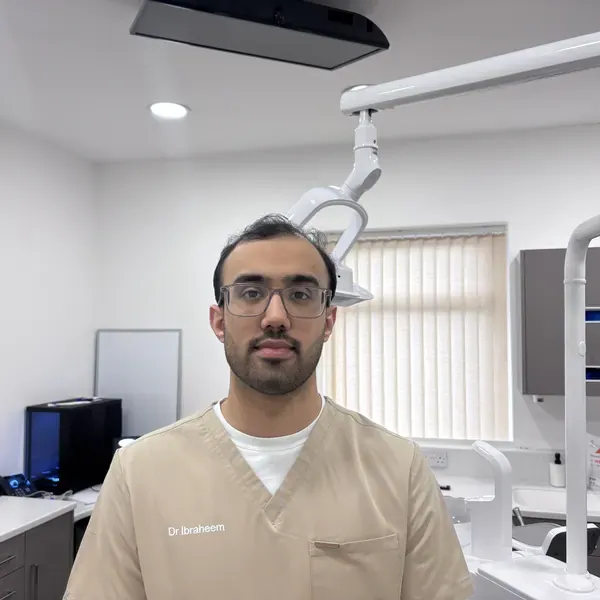 Clinically reviewed by Dr Ibraheem Ijaz, Principal Dentist · GDC 301711 · 500+ implants placed · Last reviewed August 2026
Medical disclaimer: This page is for general information only. It does not replace an examination or treatment by a dentist.
What is an implant-supported denture?
An implant-supported denture is a removable denture that clips onto two or more implants in the jawbone, instead of resting only on the gum.
It looks similar to a conventional acrylic or cobalt chrome denture; the difference sits underneath. Small attachments — Locator stud abutments or a bar — engage housings inside the denture base, so it snaps into place when seated and lifts off cleanly for cleaning. Patients sometimes search for “snap-on” or “click-in” dentures; these are the same prosthesis in everyday language.
A conventional lower full denture rests on a ridge of gum and bone that shrinks year on year, which is why so many patients find it loose despite adhesive. Anchoring it to two implants in the front of the lower jaw stops it moving during eating and speech, and helps slow further bone loss in the area immediately around them.
Most patients enquiring about implant-supported dentures are not asking what the device is — they want to know whether it can solve a daily frustration with their existing denture, often after years of loose, ill-fitting dentures.
How implant-supported dentures work
Implant-supported dentures work by transferring retention from the gum to a small number of titanium implants integrated into the jawbone.
The implants. Two implants are the established minimum for a lower overdenture, placed in the front of the mandible (the lower jaw) where bone is generally thicker. For an upper overdenture, four implants are typical because the upper jawbone is softer. Position and number are decided after a CBCT scan and clinical assessment.
The attachment. Two attachment families dominate UK practice:
- Locator (stud-type) attachments screw onto each implant, with a nylon insert in the denture that snaps onto the abutment. They are non-splinted, easier to clean around, and lower in laboratory cost; the nylon inserts are replaced as routine maintenance.
- Bar attachments join the implants with a custom-milled metal bar that the denture clips onto. The bar splints the implants, distributes load more evenly, and feels especially stable, but costs more and is harder to clean.
The McGill Consensus Statement (2002) and UK-led York Consensus Statement (2009) support a two-implant overdenture as the minimum first-choice treatment for a fully toothless (edentulous) lower jaw. The choice of attachment system is then made on bone, hygiene capability, restorative space, and budget.
Locator vs bar attachments — which is right for which patient?
The choice between Locator and bar attachments is driven by bone, cleaning ability, restorative space and cost.
A Locator-style overdenture suits patients who want the lowest practical cost route into implant stability, who have limited inter-implant space, or who would struggle with the cleaning demands of a bar. The nylon insert wears down and is swapped chairside as routine maintenance. A 1-year RCT (Boven et al., J Prosthodont Res 2020;64:26–33; n = 50) reported maxillary four-implant survival of 96.7% with locators and 97.9% with bars.
A bar-retained overdenture suits patients with adequate restorative space, good manual dexterity, and a preference for the firmest possible feel. Splinting helps when implants are not perfectly parallel; long-term retrospective data (Bömicke et al., J Clin Med 2023) report fewer attachment-related interventions over time than Locator systems.
Neither system is “better” in the abstract — what matters is matching it to the bone, the patient's home-care routine, and the realistic maintenance commitment. The broader question of which implant solution suits a particular pattern of tooth loss is covered in our guide on matching your situation to the right implant type.
Ask whether this treatment fits your case.
The treatment process and timeline
The treatment process for an implant-supported denture takes roughly three to six months from first consultation to fitting the final denture.
A typical pathway runs as follows:
- Consultation and CBCT scan — clinical examination, medical history, and a 3D scan to plan implant position. Implant consultation £100 (redeemable); CBCT £150.
- Implant placement — surgical appointment under local anaesthetic, typically 1–2 hours. Sedation is available.
- Healing — implants integrate over approximately three months in the lower jaw and three to six months in the upper. Patients wear a transitional denture during this phase.
- Attachment fitting — once integration is confirmed, the Locator abutments or bar framework are fitted.
- Final denture — a new denture is constructed to clip onto the attachments.
Most patients find the gap between surgical placement and final fit easier than expected, because it is spent in a comfortable transitional denture rather than waiting without teeth.
Implant-supported dentures vs conventional full dentures and All-on-4
An implant-supported denture sits between a conventional full denture and a fixed full-arch prosthesis — more stable than the first, more removable than the second.
Compared with a conventional full denture, it stays put during eating and speech, removes most reliance on adhesive, and helps preserve bone immediately around the implants. Compared with All-on-4 (a fixed full-arch implant prosthesis), it uses fewer implants, costs less per arch, and is removable — so cleaning around the implants is easier. The deeper trade-off with conventional dentures is explored in our comparison of implants and dentures.
At-a-glance comparison:
| Conventional full denture | Implant-supported denture | All-on-4 (fixed full arch) | |
|---|---|---|---|
| Stability | Relies on suction and adhesive | Clips firmly onto 2–4 implants | Fixed in place; non-removable |
| Removability | You remove daily | You remove daily | Only the dentist removes |
| Implants per arch | 0 | 2 (lower) / 4 (upper) | 4 |
| NHS availability | Routinely available (Band 3) | Rare; exceptional cases only | Rare; exceptional cases only |
| Cleaning under prosthesis | Easy | Easy (denture comes out) | Requires interdental aids |
Patients wanting stability without a fixed prosthesis often find an implant-supported denture the more proportionate choice.
How much do implant-supported dentures cost in Sheffield?
The cost of an implant-supported denture in Sheffield depends on the number of implants, the attachment system, the denture, and any preparatory bone work.
At Deepcar Dental Care, the cost components are:
- Implant consultation: £100 (redeemable against treatment)
- CBCT scan: £150
- Dental implants: from £2,400 each
- Full denture: from £990
- Bone grafting (if required): from £500
- Sinus lift (if required): from £1,000
UK private fees for removable implant-retained dentures typically range from around £8,000 to £12,000 per arch, covering the implants, attachment system, denture, and the surgical and laboratory time required to fit them.
Because every mouth is different, the only accurate price is one produced after a clinical examination and CBCT scan. Patients spreading the investment usually pay through Tabeo, with options up to 18 months interest-free or up to 60 months at 10.9% APR representative — covered on our dental implant finance page. A full breakdown is on our dental implant cost page.
NHS Band 3 (£332.10, April 2026) covers complex prosthodontics where eligible, but routine NHS funding for implants is rare and reserved for specific medical cases.
Ask whether this treatment fits your case.
Risks, limitations and contraindications
Implant-supported dentures carry the surgical and prosthetic risks shared by all implant treatments, plus a maintenance burden specific to removable overdentures.
The main clinical considerations are:
- Integration failure. Implant integration is not guaranteed in every case. Risk is higher in smokers, in poorly controlled diabetes, on intravenous bisphosphonates or denosumab, and where bone quality is very poor.
- Peri-implant inflammation. Plaque around implants and attachments can cause gum inflammation (peri-implant mucositis) or, untreated, bone loss (peri-implantitis). Daily cleaning of the denture and abutments is essential.
- Insufficient bone. Some patients need bone grafting or a sinus lift before implants can be placed predictably — identified on the CBCT scan.
- Ongoing maintenance. Locator nylon inserts and bar clips wear and need periodic replacement. The denture may need relining as the underlying ridge remodels, particularly in the first year.
In clinical practice, most early problems with implant overdentures relate to plaque control or attachment wear, not the implants themselves, and are managed at routine reviews.
Patients with active uncontrolled gum disease or untreated decay are not candidates until those conditions are stabilised.
Caring for implant-supported dentures
Caring for an implant-supported denture means cleaning the denture and the implant attachments daily, plus attending recall appointments for professional checks.
A practical daily routine is:
- Remove the denture overnight to let the underlying tissues rest.
- Brush the fitting surface and attachment housings with a soft brush and non-abrasive denture cleaner.
- Brush around the abutments or bar with a soft toothbrush; use interdental brushes for implants where needed.
- Soak the denture in cleaning solution as recommended.
At recall, the clinician checks the implants, gum, attachments and denture fit, replacing worn parts when needed.
Questions, answered
Frequently asked questions
Are implant-supported dentures available on the NHS?
Implant-supported dentures are not routinely available on the NHS. The NHS funds implants only in exceptional cases — typically loss of teeth from mouth cancer, significant facial trauma, or congenital conditions such as cleft palate. Patients who think they may meet these criteria need a GP or dentist referral to a hospital restorative team for assessment.
How many implants do I need for a denture?
Most lower implant-supported dentures use two implants placed in the front of the lower jaw, which long-standing professional consensus supports as the minimum standard for a fully toothless lower arch. Most upper implant-supported dentures use four implants because the upper jawbone is softer. The exact number is confirmed only after a CBCT scan and clinical assessment of your bone volume.
Can I take the denture out myself?
Yes — that is the defining feature of an implant-supported denture. You remove it daily for cleaning and clip it back onto the implant attachments when you put it back in. This is the practical difference between an implant-supported denture and a fixed prosthesis like All-on-4, where only the dentist can remove the teeth.
Will an implant-supported denture stop my jawbone shrinking?
No — but it slows the process where the implants are placed. Patients often ask this after reading conflicting information online — the variation is real, because bone behaves differently in different parts of the jaw. Implant-supported dentures help preserve bone in the area immediately around the implants, though some continued ridge remodelling is normal.
How long does an implant-supported denture last?
The implants themselves are designed to last for many years when integrated successfully and well maintained. The denture, attachments and nylon inserts wear over time and are routinely replaced — nylon inserts typically every six to twenty-four months depending on use, with the denture itself reviewed at recall and replaced when wear or fit makes that appropriate.
Will it hurt?
No — implant placement is performed under local anaesthetic, and most patients describe recovery as similar to or more comfortable than a tooth extraction. Mild swelling and tenderness for a few days is normal and managed with simple analgesia. Sedation is available for patients who feel anxious about surgical treatment.
Ready when you are
Next step
If you have worked through the questions on this page, you likely have a clearer picture of whether an implant-supported denture is the right direction.