Comparing your options
Dental Implant, Bridge or Denture — A 3-Way Comparison
This page is for adults in Sheffield with one or more missing teeth who are weighing dental implants, dental bridges and dentures. It explains how the three options differ on bone preservation, longevity, cost, aesthetics and procedure, and shows which situations tend to suit which option. The right choice depends on your bone health, budget, and whether you prefer a fixed or removable replacement.
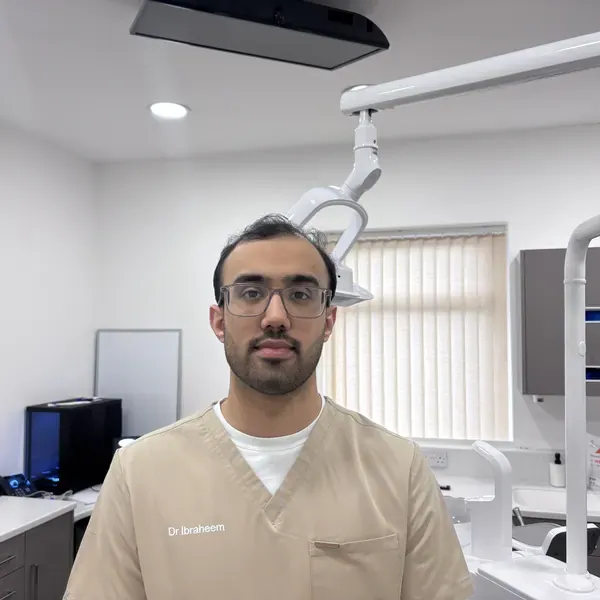 Clinically reviewed by Dr Ibraheem Ijaz, Principal Dentist · GDC 301711 · 500+ implants placed · Last reviewed August 2026
Medical disclaimer: This page is for general information only. It does not replace an examination or treatment by a dentist.
The key differences at a glance
A dental implant, dental bridge and denture each replace missing teeth in fundamentally different ways — surgically anchored, fixed to neighbouring teeth, or removable.
The table below summarises how the three options compare across the dimensions most patients in Sheffield ask about: bone preservation, longevity, effect on adjacent teeth, procedure, cost, NHS availability and aesthetics.
| Comparison | Dental Implant | Dental Bridge | Denture |
|---|---|---|---|
| Type | Fixed (surgical) | Fixed (non-surgical) | Removable |
| Bone preservation | Yes — replaces the tooth root and stimulates the jawbone | No — bone in the gap can resorb over time | No — bone in the gap can resorb over time |
| Longevity | Studies suggest around 93–96% survival at 10 years (Howe et al., 2019) | Around 80% of conventional bridges remain in place after a decade (Leeds Teaching Hospitals NHS Trust) | Variable — typically require periodic relining or replacement as the underlying bone changes shape |
| Effect on adjacent teeth | None — stands alone | Adjacent teeth typically drilled and prepared (conventional bridge) | None directly, though clasps may rest on adjacent teeth |
| Procedure | Oral surgery under local anaesthetic, followed by healing across several months | Tooth preparation and impressions; no surgery | Impressions only; no surgery |
| Cost | Private treatment from £2,400 per implant at Deepcar Dental Care | NHS Band 3 (£326.70 in England, 2025/26) where clinically appropriate | NHS Band 3 (£326.70 in England, 2025/26) where clinically appropriate |
| NHS availability | Only in exceptional cases (cancer reconstruction, severe trauma, congenital absence) | Routinely available on the NHS | Routinely available on the NHS |
| Aesthetics | Very natural — emerges from the gum like a tooth | Natural appearance, though preparation may slightly affect supporting teeth | Good aesthetics; over many years, the underlying bone may change shape, which can gradually affect denture fit and facial profile |
If you have already narrowed your decision to two of these options, our deeper dental implant vs bridge single tooth comparison and our implants or dentures which is better comparison go further into each pairing.
Dental implants — what you need to know
A dental implant (a titanium fixture placed into the jawbone that replaces the root of a missing tooth) is the only one of the three options that supports bone preservation in the area of the gap.
Many patients who enquire about dental implants are not just asking what they are — they want to know whether an implant is the right choice for their specific situation, and how it compares with the simpler options their dentist may already have mentioned.
According to the NHS, implants are titanium screws fixed into the jaw to support a crown, bridge or denture, and they are a fixed alternative to removable dentures. Because the implant integrates with the bone, it replaces the tooth root and helps maintain the surrounding jawbone over time — something a bridge or denture cannot do.
Long-term data on dental implant outcomes is reasonably strong. A 2019 systematic review and meta-analysis published in the Journal of Dentistry (Howe, Keys & Richards) reported a pooled 10-year implant survival estimate of around 96%, with a more conservative sensitivity analysis suggesting around 93%. A 2024 meta-analysis (Kupka et al., Clinical Oral Investigations) found that, depending on study design, between roughly 78% and 92% of implants are still functioning at 20 years. Outcomes vary with patient health, smoking status, and ongoing maintenance.
Limitations to consider. Implants involve oral surgery and healing over several months. They are not routinely available on the NHS. Components can loosen or wear over time, and long-term aftercare is the patient’s responsibility. Smokers face a higher risk that the implant may not integrate with the bone, as noted by Guy’s and St Thomas’ NHS Foundation Trust. Implant complications are most often linked to factors such as smoking or oral hygiene rather than the implant itself, and many issues are manageable when identified and addressed early at follow-up appointments.
Dental bridges — what you need to know
A dental bridge (a fixed false tooth anchored to one or more natural teeth either side of the gap) restores function without surgery but does not preserve the bone underneath the gap.
The NHS describes a bridge as a fixed replacement made from precious metal and porcelain, attached to the surrounding teeth. In a conventional bridge, the supporting teeth are drilled down so a crown can be cemented over them. An alternative — the adhesive (Maryland) bridge — uses a small metal wing bonded to the back of an adjacent tooth and requires very little or no drilling.
Leeds Teaching Hospitals NHS Trust reports that the majority of conventional bridges — approximately 80% — remain in place after a decade, generally with only minor complications. The same source notes that 10 to 15% of supporting teeth may eventually need root canal treatment because the nerve inside the tooth can die back over time.
Limitations to consider. Conventional bridges typically require healthy adjacent teeth to be cut down, which is irreversible. A bridge does not replace the tooth root, so the bone underneath the gap is not stimulated and can resorb over time — a process explained in more detail in our guide to how tooth loss causes the jawbone to shrink over time. If one supporting tooth fails, the entire bridge usually needs to be replaced.
Still weighing it up? Talk it through with Dr Ijaz.
Dentures — what you need to know
A denture (a removable replacement for missing teeth, available as a full set or as a partial denture filling specific gaps) is the most accessible of the three options and requires no surgery.
The NHS describes dentures as false teeth fitted in place of natural teeth, available as a full set when all teeth are missing or as a partial set to replace one or more teeth. They are generally available on the NHS as a Band 3 treatment (currently £326.70 in England) and require no surgery to fit.
Modern dentures can look natural and restore the ability to eat and smile in social settings. For patients in Sheffield who cannot have surgery — or who are not yet ready to commit to implants — a denture is often the most practical starting point.
Limitations to consider. Dentures are removable and need to be taken out for cleaning and overnight. Because they sit on the gum rather than replacing the tooth root, the bone underneath continues to resorb over time, which is one reason dentures may fit less securely after a few years and need relining or replacement. Adjusting to a new denture often takes a few weeks, particularly with certain foods or when speaking — most patients adapt with time and minor adjustments from their dentist.
Which option suits which situation?
The right choice between an implant, bridge or denture depends on bone health, budget, the number and location of missing teeth, and whether you prefer a fixed or removable solution.
The framework below is a general guide — it is not a personal recommendation. Only an in-person clinical assessment can confirm which options are realistic in your specific case.
- If you have one missing tooth and healthy neighbouring teeth that you do not want to drill into, a dental implant is often clinically preferred because it stands alone and does not affect adjacent teeth.
- If you have one missing tooth and the neighbouring teeth already need crowns or significant restoration, a conventional bridge can be a sensible option because the supporting teeth would have been prepared anyway.
- If you have several missing teeth in a row and good bone volume, an implant-supported solution may offer the most stable long-term result, while a bridge or partial denture can be a more affordable alternative.
- If you have multiple missing teeth across both arches, or full tooth loss, a denture (or an implant-supported denture for added stability) is often the most practical option.
- If preserving the jawbone underneath the gap is a priority for you, dental implants are the only one of the three options that replaces the tooth root and helps maintain bone in that area.
- If you cannot have surgery, prefer to avoid it, or need a faster, lower-cost solution, a denture or bridge is likely to be the better fit.
- If cost is the primary constraint, NHS Band 3 covers bridges and dentures in England at a fixed charge (currently £326.70), while implants are typically only available privately.
Patients arriving at this decision are often unsure which way to go, and Dr Ibraheem Ijaz approaches it by understanding what is shaping your concern — function, appearance, or long-term stability — and walking through every option honestly, including those that are not implants. Identifying which scenario fits your situation is the first step; the next is understanding what each option costs.
Still weighing it up? Talk it through with Dr Ijaz.
How much do these options cost in Sheffield?
Bridges and dentures are typically available on the NHS as Band 3 treatments at a fixed charge, while dental implants are usually a private treatment with prices starting from £2,400 per implant at Deepcar Dental Care.
In England, the NHS Band 3 charge — which covers crowns, bridges and dentures — is currently £326.70 for a course of treatment (2025/26). Dental implants are not routinely funded by the NHS and are typically only approved in exceptional cases such as reconstruction after head and neck cancer, severe trauma, or congenital conditions.
Private implant pricing varies depending on the number of implants needed, whether bone grafting or a sinus lift is required, and which implant system is used. At Deepcar Dental Care in Sheffield, implants start from £2,400, and treatment can be spread over up to 18 months interest-free or up to 60 months at 10.9% APR representative through Tabeo. These figures apply to private treatment at Deepcar Dental Care and are reviewed regularly — current figures are listed on our fees page.
Questions, answered
Frequently asked questions
Is a dental implant always better than a bridge or denture?
Patients often ask this after reading conflicting information online, and the variation in answers is real, because the right option depends on individual bone health, budget and the number of missing teeth. No single option is universally best — implants preserve bone, but bridges and dentures remain clinically appropriate in many situations.
Will a dental bridge damage my healthy teeth?
A conventional dental bridge requires the teeth either side of the gap to be drilled down so crowns can be fitted, which is irreversible. An adhesive (Maryland) bridge bonds to the back of an adjacent tooth with very little drilling. Leeds Teaching Hospitals NHS Trust notes that 10 to 15% of bridge supporting teeth may eventually need root canal treatment.
Why do dentures sometimes feel loose after a few years?
Dentures sit on the gum rather than replacing the tooth root, so the jawbone underneath the gap is not stimulated and can resorb over time. As bone shape changes, a denture that originally fitted well may begin to feel loose, which is why relining or replacement is often needed every few years to maintain comfort and function.
Can I get dental implants on the NHS in Sheffield?
NHS dental implants are only funded in exceptional cases — typically reconstruction after head and neck cancer, severe trauma, congenital tooth absence, or where conventional dentures cannot be tolerated. Most adults in Sheffield seeking implants access treatment privately. NHS bridges and dentures remain available as Band 3 treatments where clinically appropriate.
How long does each option last?
Studies suggest around 93 to 96% of dental implants are still functioning at 10 years (Howe et al., 2019), with between roughly 78 and 92% still in place at 20 years depending on study design (Kupka et al., 2024). Around 80% of conventional bridges last 10 years or longer according to Leeds Teaching Hospitals NHS Trust. Denture longevity varies and often requires periodic relining or replacement.
Can I switch from a denture or bridge to implants later?
Yes, switching is possible, but the longer the gap goes without a tooth root in place, the more the underlying jawbone may resorb, which can affect implant suitability. If switching to implants is something you may consider in future, it is worth raising at your consultation — bone volume is a key factor in planning, and our page on bone preservation through implant placement covers this in more depth.
Ready when you are
The next step
If you have worked through the questions on this page, you likely have a clearer picture of whether an implant, a bridge or a denture is the right direction for you. The next step is a conversation with a clinician who can assess your specific situation.