Treatment
All-on-6 Dental Implants Sheffield — Full Arch on 6 Implants
This page is for adults in Sheffield missing all teeth in one jaw and considering All-on-6 dental implants. It covers what All-on-6 is, how it differs from All-on-4, who is suitable, what the procedure involves, the cost at Deepcar Dental Care, and the risks. The core takeaway: All-on-6 is a fixed full-arch solution best suited to patients with sufficient bone in both anterior and posterior segments of the jaw.
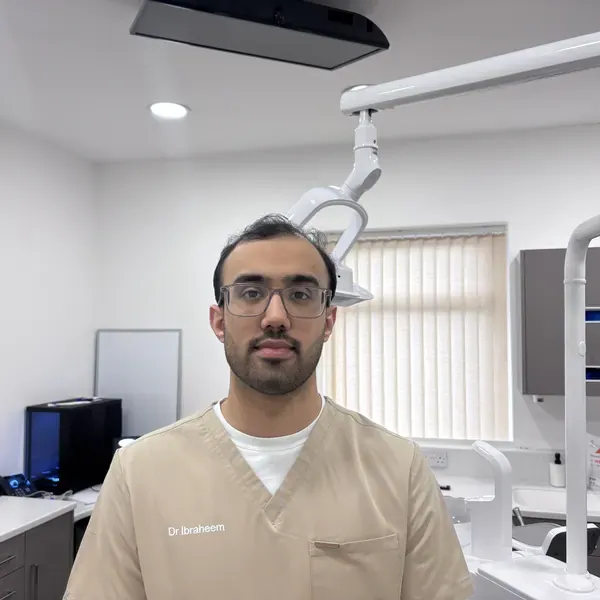 Clinically reviewed by Dr Ibraheem Ijaz, Principal Dentist · GDC 301711 · 500+ implants placed · Last reviewed August 2026
Medical disclaimer: This page is for general information only. It does not replace an examination or treatment by a dentist.
What is All-on-6?
All-on-6 is a fixed full-arch tooth replacement that uses six dental implants in one jaw to support a single non-removable bridge.
The six titanium implants are placed across the arch and integrate with the jawbone over three to six months in a process called osseointegration (the biological fusion of the implant surface with the surrounding bone). Once integrated, a permanent fixed bridge — sometimes called an implant-supported full-arch prosthesis — is screwed onto abutments connected to the implants, restoring the appearance and function of a complete arch of teeth. The bridge is not removed for daily cleaning; it is cleaned in place around and underneath the prosthetic.
The principle of axial loading — chewing forces directed along the long axis of each implant rather than at an angle — is central to the design. Spreading those forces across six fixtures rather than four reduces the load borne by each implant, which is a basic biomechanical advantage relevant to long-term outcomes. You can see how the underlying load mechanics work in our guide to dental implant biomechanics.
Many patients who enquire about All-on-6 are not just asking what it is — they want to know whether it is the right protocol for their specific bone, their specific health profile, and the function they want to restore. The honest clinical answer almost always begins with a CBCT scan, because the imaging of the jaw decides whether All-on-6 is appropriate far more than any preference for the protocol itself.
Why six implants — the stability advantage
In full-arch implant treatment, six implants distribute chewing forces across more anchor points than four, lowering the load on each fixture; in published comparative evidence, six-implant configurations are associated with less marginal bone loss than four-implant configurations.
A 2024 systematic review of 53 studies comparing maxillary fixed prostheses on four versus six implants found no statistically significant difference in implant or prosthesis survival between the two groups, but marginal bone loss around the implants was significantly higher in the four-implant group. A separate large retrospective cohort of 943 patients reported five-year implant survival of 98.4% for four-implant configurations and 98.7% for six-implant configurations — comparable, but with the six-implant group showing modest advantages over time.
More implants do not necessarily mean a higher chance of short-term success, but they can mean better load distribution, lower stress per fixture, and — based on current evidence — less bone loss around the implants over years of function.
Who is suitable for All-on-6?
All-on-6 suits adults missing a full arch who have sufficient bone in both the front and back of the jaw to support a six-implant full-arch restoration.
The defining candidacy difference between All-on-6 and All-on-4 is bone in the posterior segments. All-on-4 was specifically designed to use tilted distal implants so that posterior bone deficits — particularly in the upper jaw, where the maxillary sinus limits bone height — can be avoided. All-on-6 generally requires enough bone to place all six implants without aggressive tilting. Patients with significant posterior bone loss may need a sinus lift, a bone graft, or may be more appropriate candidates for All-on-4.
Other factors assessed at consultation include general health, smoking status, control of any diabetes, gum health, and any history of head and neck radiotherapy. A CBCT scan is used to map bone volume and density across the jaw before any treatment plan is confirmed. For complex cases, planning at Deepcar Dental Care may be carried out alongside a maxillofacial colleague to ensure the surgical and prosthetic strategy is appropriate for the individual patient.
Ask whether this treatment fits your case.
All-on-6 vs All-on-4 — when each is the right choice
The choice between All-on-6 and All-on-4 depends primarily on bone quality and quantity in the jaw, not on which protocol is “better” in the abstract.
Where bone in the posterior segments is sufficient, All-on-6 offers more anchor points, better load distribution across the fixed bridge, and — based on current comparative evidence — less marginal bone loss over time. Where posterior bone is limited, All-on-4 uses tilted distal implants to engage the available bone without grafting, which can reduce surgical complexity and shorten treatment time. For some patients, All-on-4 is genuinely the more appropriate option, and the honest answer is that the protocol is matched to the anatomy rather than chosen as an upgrade.
For a detailed look at the four-implant protocol, see our All-on-4 dental implants treatment page. The cost comparison between the two protocols is covered in the All-on-4 cost guide.
The All-on-6 procedure timeline
The full All-on-6 process typically spans three to six months from consultation to final fixed bridge, depending on healing, bone work, and prosthetic stages.
The treatment progresses through four broad stages.
Stage 1 — Consultation and CBCT planning. This visit confirms candidacy, maps the bone, and produces a detailed treatment plan and quote.
Stage 2 — Surgical placement. All six implants are placed in one session, often with same-day extractions if natural teeth need to be removed. An immediate temporary fixed bridge may be fitted on the day where primary stability — the firmness of the implant in the bone at placement — is sufficient. Where primary stability is not adequate, a delayed-loading approach is used and a removable temporary is worn during healing.
Stage 3 — Osseointegration. The implants fuse with the jawbone over three to six months. Patients eat a soft diet during this time and attend follow-up checks.
Stage 4 — Final restoration. The definitive fixed bridge is fitted, designed and milled to suit the patient’s bite, facial proportions, and aesthetic preferences.
Implant systems used at Deepcar Dental Care for All-on-6 cases include Straumann, Nobel Biocare, and Neodent — selected per case rather than by default.
Ask whether this treatment fits your case.
How much does All-on-6 cost in Sheffield?
Full-arch implant treatment at Deepcar Dental Care starts from £12,000 per jaw — the same published baseline whether four or six implants are planned.
The published full-arch fee covers implant placement and the fixed bridge superstructure. Additional costs may apply for the £100 implant consultation (redeemable against treatment), the £150 CBCT planning scan, sinus lifts (from £1,000), and bone grafting (from £500) if these are needed to support the six implants. Final cost depends on case complexity, the bone work required, and the prosthetic materials selected. A complete written quote is provided after the consultation and CBCT, with no treatment carried out until you have approved the plan and the cost.
Patients can spread payments through Tabeo, with options including up to 18 months interest-free or longer terms at 10.9% APR representative. Full terms and worked examples sit on our dental implant finance page, and a wider price breakdown is on the dental implant cost page. NHS dental implants are not routinely available; full-arch implant treatment in Sheffield is accessed through private practices.
Risks and limitations of All-on-6
All-on-6 implant treatment shares the general risks of any implant procedure: surgical risks, infection, peri-implantitis (inflammation of the gum and bone around an implant), marginal bone loss, and the possibility of an implant failing to integrate.
Specific limitations of the All-on-6 protocol include the requirement for sufficient bone in both anterior and posterior segments — without it, sinus lift or bone grafting is needed, or All-on-4 may be more appropriate. Smoking, uncontrolled diabetes, untreated gum disease, head and neck radiotherapy, and certain bone-modifying medications such as bisphosphonates are all factors that are reviewed at consultation and may affect candidacy and outcomes. Long-term success depends on excellent home cleaning around and under the fixed bridge and ongoing professional maintenance. Mechanical complications — such as wear or fracture of the bridge material — can occur over years of function and may require repair or replacement of the prosthetic component, separate from the implants themselves.
In clinical practice, complications associated with full-arch implant treatment most commonly present in the early healing phase or in patients whose home care and maintenance routine is not consistent — and most are manageable when identified early at routine follow-up. A balanced clinical conversation about these risks, in the context of your individual situation, is part of the consultation. Patients of Deepcar Dental Care share their experiences on our patient feedback and reviews page.
Questions, answered
Frequently asked questions
Is All-on-6 better than All-on-4?
Neither protocol is universally better — the right choice depends on posterior bone volume in the jaw. All-on-6 offers better load distribution and slightly less marginal bone loss when bone is sufficient, while All-on-4 is designed for patients with posterior bone deficits. The decision is made after a CBCT scan and clinical assessment.
How long do All-on-6 implants last?
Published five-year survival rates from a large recent cohort of 943 patients reported around 98.7% for six-implant configurations, with comparable long-term outcomes across multiple peer-reviewed studies. The implants themselves can last many years with good maintenance; the fixed bridge component may need repair or replacement over time due to wear, separately from the implants.
Will I have teeth on the day of All-on-6 surgery?
In many cases, yes — an immediate temporary fixed bridge can be fitted on the day of implant placement, provided the implants achieve sufficient primary stability (a measure of how firmly the implant is held by the bone at placement). The final definitive bridge is fitted after osseointegration, typically three to six months later.
How much does All-on-6 cost compared with All-on-4 in Sheffield?
At Deepcar Dental Care, full-arch implant treatment starts from £12,000 per jaw — the same published baseline whether four or six implants are planned. Final cost depends on case complexity, the need for sinus lift or bone graft, and the prosthetic materials selected. A full written quote is provided after consultation and CBCT planning.
Are All-on-6 dental implants available on the NHS?
NHS dental implants are not routinely available. They are sometimes provided by NHS hospital services for patients with severe trauma, congenital tooth absence, cancer reconstruction, or where dentures cannot be tolerated for medical reasons. Full-arch protocols such as All-on-6 fall outside standard NHS dental care, and patients in Sheffield typically access this treatment privately.
Who places All-on-6 implants at Deepcar Dental Care?
Implants at Deepcar Dental Care are placed and restored by Dr Ibraheem Ijaz (GDC 301711), an experienced implant dentist with a PG Diploma in Implant Dentistry, over 500 implants placed and restored, and continued postgraduate surgical training in implant dentistry. Complex cases may be planned alongside a maxillofacial colleague to ensure the surgical and prosthetic strategies are appropriate.
Ready when you are
The next step
A consultation with an experienced implant dentist is the only way to know whether All-on-6 suits your jaw, your health, and your goals.