Treatment
Mini Dental Implants — A Smaller Option for Specific Patients
This page is for patients who have been told they may not have enough bone for standard dental implants, and for those exploring options to stabilise loose dentures. It explains what mini dental implants are, when they are clinically appropriate, the cost in context, and the limitations to weigh before deciding. Mini implants help specific cases — they are not a universal alternative to standard implants.
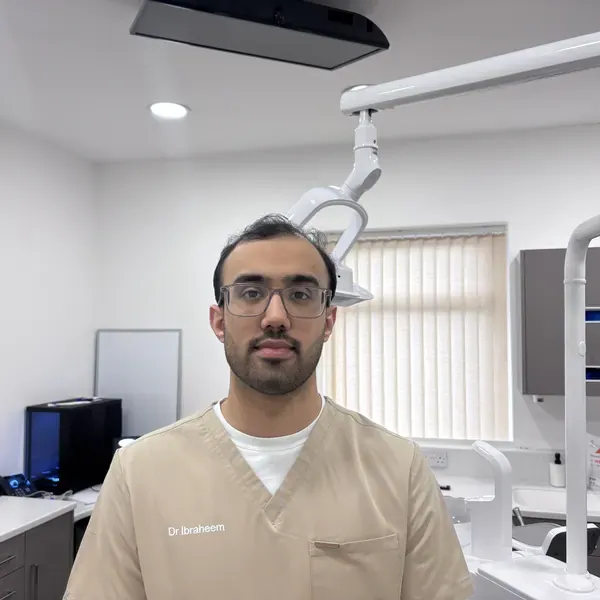 Clinically reviewed by Dr Ibraheem Ijaz, Principal Dentist · GDC 301711 · 500+ implants placed · Last reviewed August 2026
Medical disclaimer: This page is for general information only. It does not replace an examination or treatment by a dentist.
What are mini dental implants?
Mini dental implants are titanium fixtures with a diameter of less than 3 mm, used in narrow jawbones and for denture stabilisation. Standard dental implants typically sit between 3.75 mm and 4.1 mm in diameter, while mini implants — also called narrow-diameter implants (NDIs) — generally range between 1.8 mm and 3 mm.
Because the fixture is narrower, the surgery is less invasive, the placement is often single-stage, and bone grafting can sometimes be avoided in patients with insufficient ridge width. Mini implants are most commonly placed using a flapless surgical technique (where the gum is not cut and stitched), and immediate loading — fitting the prosthetic on the same day or shortly after — is commonly prescribed where primary stability is achieved at placement.
At Deepcar Dental Care, our implant work is led by Dr Ibraheem Ijaz, who has placed and restored more than 500 implants and works with internationally recognised systems including Straumann, Nobel Biocare, Neodent, Dentium and Sweden Martina. Mini implants form part of the wider Deepcar Dental Care implant services, and whether they are right for a particular patient depends on bone anatomy, the prosthetic plan and overall medical history.
Many patients who enquire about mini dental implants are not just asking what they are — they want to know whether they are right for their specific situation. The honest answer is that mini implants suit some clinical pictures very well and are wrong for others, and the size of the fixture is rarely the only factor that decides this.
When mini implants are used to stabilise dentures
Mini implants are most often used to stabilise lower dentures in patients whose jawbones are too narrow for standard implants. The clinical scenario this addresses is common: patients who have worn complete dentures for many years frequently develop bone resorption (gradual loss of jawbone volume), and a loose lower denture can become a daily problem — affecting eating, speaking and confidence.
A typical case in this scenario involves placing four mini implants in the lower jaw, into which the existing or a new denture clips securely. The denture remains removable for cleaning, but it stays firmly in place during normal function. Systematic review evidence on mini-implant-retained overdentures reports cumulative survival of around 91% at seven-year follow-up, with notably better outcomes in the lower jaw than the upper jaw.
Maxillary (upper jaw) overdentures supported by mini implants are clinically more demanding and show a substantially higher failure rate than mandibular (lower jaw) cases, which is why patient selection matters. Where the upper jaw is involved, or where wider load distribution is needed, evidence shows that four mini implants produce better survival outcomes than two for mandibular overdentures.
Who is suitable for mini dental implants?
Mini implants suit patients with narrow alveolar ridges, adequate bone height, and prosthetic needs that fall within the load tolerance of smaller fixtures. The clinical assessment for mini implant candidacy looks at bone width, bone height, the location of the missing teeth, the patient's medical history, and the planned restoration.
Mini implants tend to be most appropriate when:
- the lower denture is loose and the patient wants a fixed solution without bone grafting,
- bone width is insufficient for standard implants but bone height is sufficient to accommodate a 7–18 mm fixture (assessed on CBCT imaging),
- the patient prefers a less invasive procedure with shorter recovery,
- and the prosthetic plan does not place heavy occlusal load on a single mini fixture.
Where bone volume is borderline, a CT scan reveals whether you have enough bone for either mini or standard placement. Age is rarely the deciding factor on its own — patients into their seventies and eighties are routinely treated where overall health permits — but the age limits for dental implants in the UK are best understood case by case. Comparing implant types side by side helps clarify the decision; our guide on which dental implant type do I need sets out the framework.
Ask whether this treatment fits your case.
How does the mini dental implant procedure work?
The mini dental implant procedure is typically completed in a single visit under local anaesthetic, with the prosthetic often fitted immediately or shortly afterwards. The standard sequence for a mini implant case begins with a CBCT scan (cone beam CT — a 3D X-ray of the jaw) to map the bone, followed by a digital plan, the surgical placement itself, and the fitting or adjustment of the denture or crown.
Because mini implants are usually placed flaplessly, most patients experience less swelling and a shorter recovery than after standard implant surgery. Soft food is recommended for the first few days, with normal function returning gradually as the site heals; specific aftercare guidance is given at the placement appointment.
For complex cases involving mini or standard implants — including patients with significant bone deficiency or medically complex backgrounds — treatment at Deepcar Dental Care may be carried out as a duo with maxillofacial specialist Mohammed Anabtawi . Not every case is suitable for a mini implant approach, and the consultation visit is where that decision is made — based on imaging, clinical examination and a full discussion of the alternatives.
How much do mini dental implants cost?
Mini dental implant fees vary by case and by clinic, with the final fee shaped by the number of implants placed, imaging, and the prosthetic plan. Where mini implants are placed instead of standard implants, the fee can sometimes be lower because the procedure is shorter and bone grafting is often avoided — but the relationship between procedure type and final fee is not fixed and is confirmed only in a written treatment plan.
At Deepcar Dental Care, all implant treatment begins with a £100 implant consultation (which is offset against treatment cost) and a £150 CBCT implant scan where indicated. A full written treatment plan is provided before any work begins, with all costs explained in advance. Specific mini-implant fees are confirmed at consultation — published treatment fees and the full cost breakdown for dental implants in the UK sit on dedicated pages and are reviewed periodically.
Finance is available through Tabeo Finance Limited (FCA 777539), with up to 18 months interest-free or up to 60 months at 10.9% APR representative — both subject to status. NHS-funded dental implants, mini or standard, are not routinely available; treatment under the NHS is restricted to specific clinical situations decided by hospital consultants.
Ask whether this treatment fits your case.
Limitations of mini implants compared with standard implants
Mini implants have lower long-term predictability than standard implants, are less suited to molar replacement, and require ongoing prosthetic maintenance. Pooled survival rates for mini implants under 3 mm have been reported at around 95% in clinical research, but with significantly higher failure rates than standard-diameter implants in head-to-head meta-analysis.
In practical terms, mini implants are generally not the right choice for replacing a single posterior molar, where chewing forces are highest, and they require careful selection in the upper jaw, where survival rates fall below those seen in the lower jaw. Severe bruxism (heavy teeth grinding), active untreated periodontal disease, current bisphosphonate therapy (particularly intravenous formulations), recent head and neck radiotherapy, and uncontrolled diabetes are recognised risk factors that affect candidacy and require careful clinical assessment.
In clinical practice, the majority of mini implant complications surface in the early healing months and are most commonly related to load and case selection rather than to the fixture itself. Most are manageable when identified early at routine review appointments.
Mini-implant-retained overdentures show notable rates of attachment-part wear and prosthesis fracture during follow-up, which means routine maintenance visits are part of long-term care. None of these points rule mini implants out — they shape who they are right for. The honest answer in some cases is that a standard implant, a bridge, a conventional denture, or no treatment at all is the better option, and that decision is made together at consultation.
Questions, answered
Frequently asked questions
Are mini dental implants permanent?
Patients often ask this after reading conflicting information online, and the variation in answers is real because "permanent" means different things for the implant fixture and for the prosthetic on top of it. The titanium component integrates with the jawbone and remains in place for many years in successful cases, while the prosthetic attachments and the denture or crown wear over time and need periodic replacement.
Can mini implants be used to replace a single back tooth?
Mini implants are generally not the first choice for replacing a single posterior molar. Chewing forces in the back of the mouth are substantial, and a narrow-diameter fixture has a smaller margin for managing those loads. Standard-diameter implants are usually more predictable for single molar restoration. A clinical assessment confirms what is appropriate for an individual case.
How much do mini dental implants cost in the UK?
Mini dental implant fees vary by clinic and case. The final fee depends on the number of implants placed, imaging, and the prosthetic plan, and is shaped by whether the treatment supports a single tooth, a denture, or a wider prosthetic plan. At Deepcar Dental Care, fees are confirmed in a written treatment plan before any work begins.
Are mini dental implants available on the NHS?
Mini dental implants are not routinely available on the NHS. NHS-funded implant treatment is limited to specific medical situations — such as following major trauma, head and neck cancer treatment, or congenital absence of teeth — and is provided only within hospital consultant settings. For most patients, mini implants are accessed privately.
How long does mini implant treatment take from start to finish?
Mini implant treatment is often completed in fewer visits than standard implants. The surgical placement itself usually takes around an hour, and immediate loading of a denture or temporary prosthetic is common where primary stability allows. Patients typically attend a planning consultation, the placement appointment, and follow-up reviews. The full mini implant treatment timeline depends on healing, prosthetic complexity, and individual response.
Will mini implants work if I have worn dentures for many years?
Patients ask this because the answer they have been given elsewhere often depends on who they spoke to, and the variation reflects real differences in bone anatomy between long-term denture wearers. Long-term denture wearers are often the patients mini implants help most, provided enough bone remains. Years of wearing a denture usually involves some bone resorption, and mini implants are specifically designed for narrow ridges where standard implants would otherwise need a bone graft.
What happens if a mini implant fails?
Mini implant failure is uncommon when case selection is right, but it can happen — most often in the early healing months, or where occlusal load on the fixture is too high. A failed mini implant can usually be removed without complex surgery, and the site is reviewed before deciding whether to replace it, switch to a standard implant, or revise the prosthetic plan.
If you have worked through the questions on this page, you likely have a clearer picture of whether mini dental implants are the right direction for your situation. The next step is a conversation with a clinician who can assess your specific bone anatomy, your prosthetic needs, and the alternatives that would also be appropriate.
→ Book a consultation with Dr Ibraheem Ijaz at Deepcar Dental Care. A clinical assessment is the only way to know whether mini dental implants suit your situation. Call 0114 288 2121 or visit us at 334 Manchester Road, Sheffield S36 2RH. We will explain your options clearly, including alternatives to mini implants, and confirm fees in writing before any treatment begins.
For a wider view of treatment types, start your dental implants journey at Deepcar Dental Care.
Ready when you are
Book your implant assessment.
Online in under a minute, or call and speak to a real person.