Treatment
Multiple Dental Implants — Replacing Several Missing Teeth
This page is for anyone replacing two or more missing teeth with dental implants. It covers when to choose individual implants, when an implant-supported bridge is more efficient, how planning differs from single-tooth cases, and what it costs. Expect fees from around £2,400 per implant, with fewer implants typically needed than teeth. Core takeaway: fewer implants than teeth is usually the right plan — the ratio affects bone load, surgery time, and price.
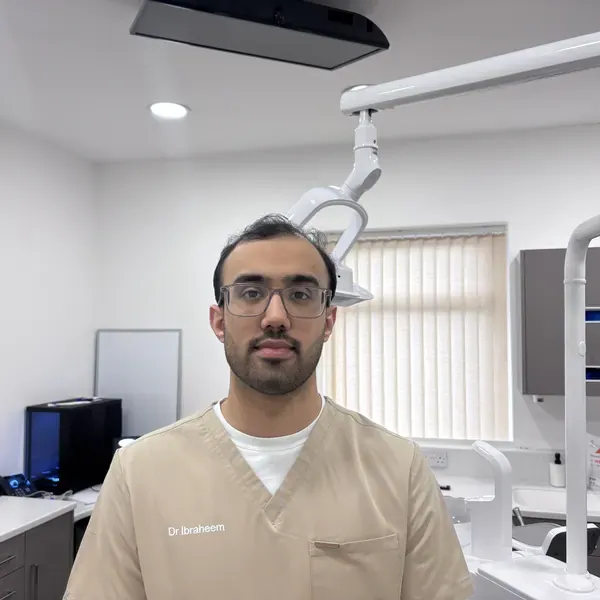 Clinically reviewed by Dr Ibraheem Ijaz, Principal Dentist · GDC 301711 · 500+ implants placed · Last reviewed August 2026
Medical disclaimer: This page is for general information only. It does not replace an examination or treatment by a dentist.
What are multiple dental implants?
Multiple dental implants are two or more titanium tooth roots placed in the jaw to replace several missing teeth, individually or via a bridge.
When several adjacent teeth are missing, there are two core approaches. The first uses one implant per missing tooth, each restored with its own crown. The second — an implant-supported bridge — uses fewer implants than teeth being replaced, with the end implants anchoring a single connected restoration that spans the gap. An implant bridge commonly replaces three teeth on two implants, or four to five teeth on three implants. The right option depends on the pattern of tooth loss, the bone available, bite forces across the span, and the patient's preference on cost versus maintenance. Both approaches use the same implant systems available at the practice — Straumann, Nobel Biocare, and Neodent — and both are restored to look and function like natural teeth when planned correctly. An implant-supported bridge is one form of implant-retained restoration — a connected replacement anchored to implants rather than natural teeth.
Many patients enquiring about replacing two or three missing teeth arrive with one number in mind — they assume one implant per tooth. The first conversation is rarely about the surgery; it is about whether that assumption is the right starting point for their specific case.
How an implant-supported bridge works across a gap
An implant-supported bridge uses two or more implants as anchors, with connected replacement teeth — called pontics — spanning the space between them.
Unlike a traditional bridge, which grinds down healthy neighbouring teeth for support, an implant-supported bridge stands entirely on its own implants. The end implants carry the bite load, and the pontics transfer chewing forces back to those anchor implants. This is why fewer implants can support more teeth: the bridge distributes force across the fixtures rather than placing one implant under every single tooth. The biomechanical trade-off is that each anchor implant carries more load, so implant length, diameter, and spacing all become central to the plan. The engineering of how load distributes across anchor implants and pontics is explored in detail on the page covering stress distribution differences between single and multi-unit implants. In practice, implants are typically positioned with around 3 mm between fixtures and around 1.5 mm from any adjacent natural tooth root — clinical norms rather than fixed rules, varying by implant system and case.
Typical multi-unit scenarios — 2, 3, and 4–5 missing teeth
The treatment approach for multiple implants scales with the number and position of the missing teeth, not just the count.
Two adjacent missing teeth. Two options usually apply. Two individual implants with two separate crowns give each tooth its own support and make each unit independently cleanable. A two-implant, two-crown approach is often appropriate when the gap is non-continuous or when the bone is suitable. A two-implant bridge is generally not used for only two teeth — it offers no efficiency gain over two individual crowns.
Three adjacent missing teeth. This is the classic implant-supported bridge scenario: two implants at the ends, with a pontic in the middle. Three individual implants remain a valid alternative where bone quality, spacing, and budget allow — and may be preferred in areas with heavy bite forces, such as the back of the lower jaw.
Four to five adjacent missing teeth. Three implants supporting a four- or five-unit bridge is a common approach, though the exact configuration depends on bone volume across the span, bite forces, and where the gap sits in the arch. Posterior (back) sections carry stronger chewing loads and sometimes need an extra implant for long-term stability.
This page focuses on replacing a section of the arch. Replacing a full upper or lower arch uses a different protocol — the All-on-4 full arch treatment is covered separately.
Ask whether this treatment fits your case.
What affects your multi-unit treatment plan
Four factors shape a multi-unit implant plan: the number and position of missing teeth, bone volume, bite forces across the span, and general health.
Bone assessment is the foundation. A cone beam CT (CBCT) scan gives a three-dimensional view of ridge width, ridge height, sinus position in the upper jaw, and the inferior alveolar nerve (the main sensory nerve running through the lower jaw) in the lower jaw. Where there is not enough bone to place implants of adequate size and position, a bone graft or sinus lift may be recommended before — or alongside — implant placement. Bite forces matter because multi-unit cases concentrate load on fewer implants; patients who clench or grind (bruxism) may need a night guard and sometimes adjustments to the plan. General health conditions such as uncontrolled diabetes, current oncology-dose bisphosphonate therapy, or recent head-and-neck radiotherapy can make implants unsuitable or require specialist liaison. A history of periodontal disease also matters — evidence from systematic review shows implant survival in fixed partial dentures is lower in patients with a history of periodontitis than in those without, so periodontal disease should be treated and stabilised before implants are placed (Sanz-Sánchez et al., 2022).
What to expect — timeline and process
A multi-unit implant case typically spans three to nine months from consultation to final restoration, depending on whether bone grafting is needed.
At Deepcar Dental Care, the pathway starts with a £100 implant consultation — redeemable against treatment — followed by a £150 CBCT scan to plan implant positions in three dimensions. Surgical placement of several implants is usually completed in a single visit; patients who are anxious may opt for conscious sedation. A healing period of typically three to six months allows each implant to integrate with the bone. Temporary teeth are often fitted so the patient is not without a smile. Once integration is confirmed, impressions are taken and the final bridge or individual crowns are made in the laboratory and fitted at a follow-up appointment. Where bone grafting is required, the overall timeline extends — a graft may need three to six months to mature before implants can be placed. Throughout treatment, Dr Ijaz handles planning, placement, and restoration in-house; complex cases are managed as a duo with specialist colleague Mohammed Anabtawi.
Cost — multi-unit implants versus individual implants
Replacing several teeth with an implant-supported bridge is often less expensive per tooth than individual implants, because fewer implants are placed.
At Deepcar Dental Care, dental implants start from £2,400 per implant. Exact inclusions for a multi-unit plan — implants, abutments, connected bridge, laboratory work — are itemised in your written treatment plan after consultation. Verify the current figures on our published fee schedule. For a three-tooth section, three individual implants would be broadly three times the single-implant starting fee, before abutments, crowns, and laboratory work are added, while a two-implant bridge uses two implants plus a three-unit connected bridge, which typically produces a lower total fee. For a four- or five-tooth section, a three-implant bridge shows a larger per-tooth saving compared with four or five individual implants. Exact figures also depend on the implant system used and whether bone grafting or a sinus lift is needed (from £500 and from £1,000 respectively). A written plan with itemised fees is always provided before treatment starts. For a detailed breakdown of how the number of implants, bone grafting, and crown type affect your total cost, see the main implant cost page. Finance is available through Tabeo — up to 18 months interest-free and up to 60 months at 10.9% APR representative, subject to status.
Many patients at Deepcar Dental Care report that having one team handle planning, surgery, and final restoration made the overall cost easier to follow, with fewer separate fees to track.
Ask whether this treatment fits your case.
Risks and limitations of multi-unit implant treatment
Multi-unit implant cases carry the same core risks as single implants, plus added considerations around biomechanics, complication rates, and long-term maintenance.
Implant survival data from peer-reviewed systematic review (Pjetursson et al., 2012) shows implants supporting fixed dental prostheses have an estimated 95.6% survival at 5 years and 93.1% at 10 years. For metal-ceramic implant-supported bridges specifically, prosthesis survival is estimated at 96.4% at 5 years and 93.9% at 10 years. However, complications are common: only 66.4% of patients with implant-supported bridges are complication-free at 5 years. The most frequent issues are veneer fractures (around 13.5% over 5 years), peri-implantitis and soft-tissue complications (around 8.5%), screw loosening (around 5.3%), and loss of retention on cemented bridges (around 4.7%). In clinical practice, these complications are most often linked to maintenance access and bite-force distribution rather than implant failure itself — the implant body fails less frequently than the components above it. Most are manageable when identified early, which is why a planned maintenance schedule matters more for multi-unit cases than for single crowns. Smoking, uncontrolled diabetes, untreated gum disease, and heavy clenching or grinding all raise the long-term risk of failure. Cleaning under a bridge also requires specific technique — interdental brushes, superfloss, or a water flosser — that differs from cleaning around individual implants.
References
1. Pjetursson BE, Thoma D, Jung R, Zwahlen M, Zembic A. A systematic review of the survival and complication rates of implant-supported fixed dental prostheses (FDPs) after a mean observation period of at least 5 years. Clinical Oral Implants Research 2012; 23(Suppl 6):22–38. PubMed ID: 23062125.
2. Sanz-Sánchez I, Carrillo de Albornoz A, Figuero E, et al. Effectiveness of implant-supported fixed partial denture in patients with history of periodontitis: A systematic review and meta-analysis. 2022. PubMed ID: 34775625.
3. NHS Business Services Authority. NHS England dental charges poster — April 2026. NHSBSA official publication.
Questions, answered
Frequently asked questions
How many implants do I need to replace 3 or 4 missing teeth?
Three adjacent missing teeth are typically replaced with a two-implant bridge, while four missing teeth usually need three implants supporting a four-unit bridge. The final number depends on bone volume, position in the arch, and bite forces. A CBCT scan confirms the plan before treatment starts.
Is an implant-supported bridge as strong as individual implants?
An implant-supported bridge can be as functionally strong as individual implants when the anchor implants are sized, positioned, and loaded correctly. The total chewing force across the span is distributed to fewer fixtures, so implant dimensions and placement are planned specifically for that load. Both approaches restore normal chewing in most patients.
Can I have multiple implants if I have bone loss?
Bone loss does not automatically rule out multiple implants, but it often means a bone graft or sinus lift is needed before or alongside placement. A CBCT scan shows exactly where bone is adequate and where augmentation is needed. Grafting procedures add time to the treatment but can open up options for some patients previously told bone volume would prevent implants. Medical conditions affecting healing are assessed separately.
Are multiple dental implants available on the NHS?
Patients often ask this after seeing conflicting information online — eligibility is decided case-by-case in a hospital setting, not through a standard NHS pathway. NHS-funded implants are limited to exceptional cases such as congenital tooth absence, head and neck cancer, or significant trauma. For most multi-tooth replacements, implants are private. If NHS funding is approved, treatment falls under Band 3 (£332.10 from April 2026).
How long will multiple dental implants last?
With good maintenance, implant-supported bridges have approximately 96% prosthesis survival at 5 years and 94% at 10 years for metal-ceramic designs (Pjetursson et al., 2012). Most implant-supported bridges exceed a decade of service, though veneer chips or screw-level repairs during that time are relatively common. Long-term outcome depends on hygiene, smoking status, and gum health.
Can I have multiple implants placed in a single appointment?
Yes — several implants are typically placed in one surgical visit, often under local anaesthetic with optional sedation. Healing and final restoration occur across subsequent appointments. Same-day placement of implants does not mean same-day final teeth — full-arch same-day solutions like All-on-4 are a separate protocol that does not apply to partial multi-unit cases.
If you have worked through the questions on this page, you likely have a clearer picture of whether multiple implants or an implant-supported bridge fits your situation. The next step is a conversation with a clinician who can assess your specific case. Book an implant consultation with Dr Ibraheem Ijaz — book online at Deepcar Dental Care or call 0114 288 2121. The £100 consultation fee is redeemable against treatment and includes a full clinical assessment. Our Sheffield practice serves patients from across Sheffield and South Yorkshire. Still choosing between treatment options? See which dental implant type do I need. For the full service overview, return to dental implant solutions for missing teeth.
Ready when you are
Book your implant assessment.
Online in under a minute, or call and speak to a real person.