Complications
Implant Crown Fracture: Why It Happens and What Can Be Done
This page is for anyone whose dental implant crown has cracked, chipped or fractured. It explains why implant crowns break, whether the implant beneath is affected, and the repair or replacement options available at Deepcar Dental Care in Sheffield. The key point: a fractured crown is usually a fixable prosthetic problem, not a failed implant.
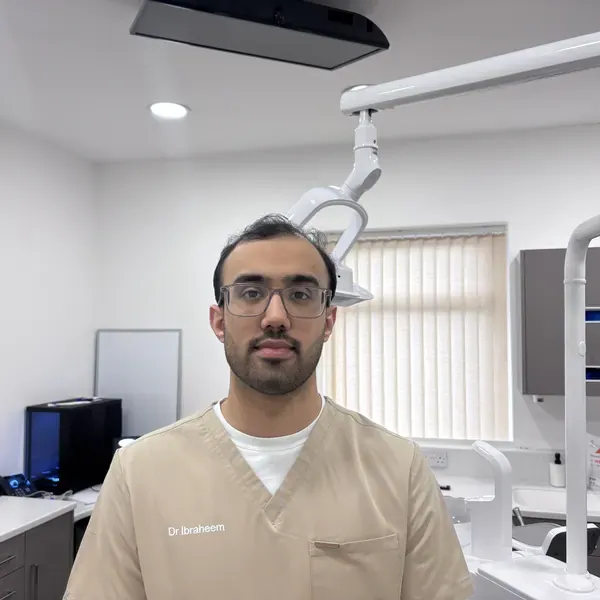 Clinically reviewed by Dr Ibraheem Ijaz, Principal Dentist · GDC 301711 · 500+ implants placed · Last reviewed August 2026
Medical disclaimer: This page is for general information only. It does not replace an examination or treatment by a dentist.
What a cracked or fractured implant crown means
A cracked implant crown means the visible restoration is damaged, while the titanium implant anchored in your jawbone almost always remains intact and stable.
Many patients who arrive with a cracked crown are worried they are about to lose the whole implant, and that concern is understandable given how alarming a broken tooth can feel. A dental implant has three parts: the implant (the titanium post fixed in the bone), the abutment (the connector), and the crown (the ceramic tooth you see and chew with). When people say their implant has "broken," it is usually the crown that has cracked, chipped or fractured, not the post holding it. That distinction matters, because the crown can be repaired or remade without disturbing the implant beneath.
There are two different kinds of crown damage. The first is chipping, where a small piece of the outer porcelain flakes away but the crown stays in place. The second is a structural or core fracture, where the crown itself splits. Systematic reviews of implant single crowns report that surface chipping is among the most common technical issues, while deeper core fractures are much less frequent, and that crown survival stays high across five to ten years of use. So once the crown is repaired or replaced, most patients regain full function and a natural appearance. Understanding where the crown sits within the complete guide to dental implants helps explain why damage to the visible tooth rarely threatens the foundation supporting it.
Why implant crowns crack
Implant crowns usually crack because of heavy or uneven bite forces, teeth grinding, or the type of ceramic used to make the crown.
An implant is fixed rigidly to the bone through osseointegration (the process by which bone fuses to the implant surface), without the cushioning periodontal ligament (the natural shock-absorbing tissue around a real tooth root). Because that natural shock absorber is absent, chewing and clenching forces pass more directly into the crown and its components. Grinding and clenching are a significant contributor to crown fractures, and patients who grind benefit from night guard protection for implant patients who grind to reduce the load reaching the restoration.
Material choice is the other major factor. Crowns built with a layer of veneering porcelain over a core are more prone to that outer layer chipping than full-contour designs, and evidence suggests the way a crown is constructed measurably affects its fracture risk. The position of the tooth in the mouth also plays a part, as back teeth generally carry greater biting forces than front teeth. None of these causes means the treatment has failed. They point instead to factors that can be managed when the crown is repaired or replaced.
Concerned about an implant? Call us — do not wait.
Repair or replacement: what happens next
Small porcelain chips can sometimes be smoothed or repaired inside the mouth, while larger fractures usually mean the crown is remade.
For a minor chip, a dentist may polish the rough edge or add a small composite repair to restore shape and comfort. This is a quick, conservative option, though it tends to be a shorter-term fix rather than a permanent one. For a larger fracture, or when the crown is a solid single material that cannot be layer-repaired, the usual pathway is to remove the damaged crown and fit a new one onto the existing implant and abutment.
How easily that happens depends on how the crown was attached. Screw-retained crowns can be unscrewed and replaced with relatively little disruption, whereas cemented crowns can be more involved to remove. The engineering behind this, including dental implant abutment types and retrievability, determines how straightforward a replacement will be. In nearly all cases the implant and often the abutment are reused, and only the crown is renewed. Costs depend on whether a repair or a full remake is needed, and current ranges are set out in the full cost breakdown for dental implants in the UK.
Choosing a crown material to reduce future fracture risk
Choosing a stronger, full-contour crown material and protecting it from grinding are two of the most effective ways to lower future fracture risk.
Crown materials involve a genuine trade-off. Full-contour (monolithic) zirconia crowns are highly resistant to chipping because there is no separate veneering layer to flake away, which makes them a robust choice for back teeth and for patients who grind. Porcelain-fused-to-metal and veneered designs can offer excellent aesthetics, particularly in the visible smile zone, but the outer porcelain is more vulnerable to chipping under heavy load. Weighing zirconia versus porcelain-fused-to-metal for implant crowns at the planning stage lets the material be matched to your bite and the tooth's position.
Protection matters as much as material. Where grinding is present, a custom night guard worn while sleeping spreads biting forces and gives the crown a protective surface, and evidence suggests this reduces wear on the restoration. Combining the right material with the right protection is what lowers the chance of a repeat fracture.
Risks and limitations
Crown repairs have limits: a smoothed chip is often a short-term fix, and repeated fractures usually point to an underlying bite problem that must be addressed.
A composite repair or polish restores comfort quickly, but it does not carry the same durability as the original crown, so a remake may still be needed later. As a temporary measure it buys time rather than resolving the fracture permanently. Solid single-material crowns generally cannot be layer-repaired and are replaced rather than patched. Most importantly, a crown that fractures more than once is signalling something about the way the teeth meet or about grinding forces. Replacing the crown without addressing that cause tends to lead to the same outcome again.
In practice, the more useful conversation goes beyond replacing the crown to why it broke, so the same problem is not simply rebuilt back into the mouth. A night guard is protective management rather than a cure, and current evidence that splints prevent implant failure outright is limited. The realistic aim is fewer complications and a longer-lasting crown, achieved through the right material, occlusal protection, and regular reviews. Patients at Deepcar Dental Care are often reassured to learn that a cracked crown is a manageable, fixable event rather than the loss of their implant.
Questions, answered
Frequently asked questions
Will I lose my implant if the crown cracks?
No, a cracked crown almost never means losing the implant. The titanium post is fixed separately in the bone and stays in place while the damaged crown above it is repaired or replaced. The implant and abutment are usually reused, so only the visible crown is renewed.
Is a cracked implant crown a dental emergency?
A cracked implant crown is rarely a true emergency, but it should be seen promptly. Sharp edges can irritate the tongue or cheek, and continuing to chew on it can enlarge the fracture. Contacting the practice quickly means the crown can be smoothed for comfort and a repair or replacement planned.
Can a chipped implant crown be repaired without removing it?
Yes, a minor chip can sometimes be managed without removing the crown. A dentist may polish the edge or bond a small composite repair to restore shape and comfort. This suits small surface chips; a larger fracture generally needs the crown taken off and remade on the existing implant.
How long should a replacement implant crown last?
A replacement crown is designed to be a long-term restoration, and how long it lasts depends heavily on daily factors. Your bite, the material chosen, oral hygiene, and whether grinding is controlled all influence its lifespan. Protecting the crown from excessive force and keeping regular check-ups are the biggest things within your control.
Does grinding my teeth mean my new crown will crack again?
Grinding raises the risk of a repeat fracture, but it can be managed. A custom night guard worn during sleep spreads the forces that would otherwise concentrate on the crown. Addressing grinding alongside the crown replacement is what reduces the chance of the same damage happening again.
Are zirconia crowns less likely to crack than porcelain ones?
Full-contour zirconia crowns resist chipping better than layered porcelain designs because there is no separate veneer to flake away. Porcelain-based crowns can look outstanding in the smile zone but are more prone to surface chips under heavy load. The best choice depends on the tooth's position and your bite.
Ready when you are
Book your implant assessment.
Online in under a minute, or call and speak to a real person.